If you wear scleral lenses — for keratoconus, severe dry eye, post-surgical irregularity, or any corneal condition that ordinary contacts cannot handle — the right eye drops are part of the system, not an afterthought. The wrong drop can cloud your lens within minutes, the wrong preservative can quietly damage your ocular surface over months, and a drop that is perfect for regular contact wearers can be entirely unsuitable for sclerals. The short answer: preservative-free saline for filling the reservoir, contact-safe preservative-free lubricating drops for over-lens comfort, and prescription drops only on your clinician’s direct instruction.
This guide from Visual Aids Centre walks through the specific drop categories that are safe with scleral lenses, the ones that look harmless but quietly compromise your wear, exactly how to apply drops with lenses in place, and the signs telling you that your eyes — or your lenses — need extra moisture.
Key Takeaways
- Use preservative-free saline to fill the reservoir before insertion — never tap water, never preserved saline.
- Contact-safe preservative-free lubricating drops are the correct choice for comfort during wear.
- Avoid drops containing benzalkonium chloride (BAK), vasoconstrictors, or oils — all three damage lenses or eyes.
- Thick gels are for overnight use after lens removal, not during wear.
Why Scleral Lens Wearers Need Drops Specifically
Scleral lenses vault over the cornea and rest on the sclera, creating a fluid-filled space between the lens and the eye’s surface. That reservoir is the reason scleral lenses transform life for people with severely irregular corneas — they replace the cornea’s optical role with the lens’s perfect curvature and bathe the eye in constant lubrication. But that reservoir also means your drops are doing two different jobs: filling the reservoir before insertion, and refreshing moisture during long wear. The drops suited for each role are different, and mixing them up is the single most common mistake new scleral patients make.
Our broader guide on what scleral lenses actually are covers the design in more detail, and how scleral lenses improve vision in irregular corneas explains why reservoir hydration is non-negotiable.
Reservoir Fill — The Drop That Goes Inside the Lens
Before you insert a scleral lens, you fill the concave side — the bowl — with preservative-free saline. This fluid sits against your cornea for the entire wearing day, making the choice of saline unusually high-stakes. Two rules are non-negotiable: preservative-free only, and designed for ophthalmic use only.
FDA-cleared options most widely used by scleral patients include LacriPure, ScleralFil, and Purilens Plus. These single-use vials are isotonic (matched to natural tear salinity), sterile, and free of the preservatives that damage the corneal surface with chronic exposure. Multi-use preserved saline bottles — even those labelled “for sensitive eyes” — contain agents like benzalkonium chloride that scleral wearers should never put into the reservoir. Tap water, bottled drinking water, and contact-lens solution with cleaning agents are all flatly unsafe in the reservoir and have been linked to serious corneal infections including Acanthamoeba keratitis.
If you are also managing dry-eye disease, our article on what causes dry eyes covers the underlying drivers worth addressing alongside lens wear.
Over-Lens Lubrication — Comfort Drops During Wear
Even with a perfect reservoir, most scleral wearers experience some end-of-day dryness as the fluid exchanges with the tear film and the lens surface itself dries slightly. Contact-safe preservative-free lubricating drops are designed for this — they are applied directly onto the eye while the lens is in place, and their formulation is engineered not to cling to or cloud the lens material.
Widely used options include Refresh Contacts, Blink Contacts, and Systane Ultra PF. Look for the “safe for contact lens wear” label, the “preservative-free” designation, and a single-use vial or preservative-free multi-dose bottle. Drops that are not labelled contact-safe may contain mild oils, lipid components, or viscosity agents that leave residue on the lens surface, producing that frustrating mid-afternoon cloudy vision that won’t blink away.
Overnight and Post-Removal Drops
Thick lubricating gels — Refresh Lacrilube, GenTeal Tears Severe Dry Eye, Systane Nighttime — are excellent for the dryness that may persist after lens removal at the end of the day, but they are never applied during lens wear. Their viscosity is designed to coat the eye slowly overnight, exactly the property that would blur vision and cling to the lens surface if used while sclerals are in place. Apply these after removing your lenses, ideally at bedtime. If you are prone to waking with dry, irritated eyes, morning dry eye covers the underlying causes and management strategies.
Prescription Drops With Sclerals
Medicated eye drops — steroids like loteprednol, immunomodulators like cyclosporine, antibiotic drops, glaucoma drops — each require a specific conversation with your prescribing clinician about scleral compatibility. Some are safe to use with lenses in. Others must be instilled before lens insertion or after removal to avoid preservative build-up in the reservoir or altered drug absorption. Autologous serum drops, sometimes prescribed for severe ocular surface disease, are typically used with lenses in but need specific storage and handling.
Never assume a prescription drop is compatible without asking. Compatibility depends on the preservative system, viscosity, and intended mechanism of the medication — and your lens fitter or ophthalmologist will give you the correct instruction for your specific regimen.
Drops to Strictly Avoid
- Anything containing benzalkonium chloride (BAK) — this preservative accumulates in the reservoir and causes progressive ocular surface toxicity. Many multi-use drops include it; check the label.
- Redness-reducing drops (containing tetrahydrozoline, naphazoline, or brimonidine for cosmetic use) — these are vasoconstrictors that mask rather than treat the cause of redness, and long-term use can worsen ocular surface health. Scleral patients should never use them over their lenses.
- Oily or lipid-based drops not labelled contact-safe — leave residue on the lens surface, produce fogging, and are difficult to clean off.
- Thick gels and ointments during wear — cause immediate blurring and cling to the lens.
- Multi-purpose contact lens solutions — formulated for cleaning, disinfecting, and storing, not for eye use. They contain cleaning agents that should never touch the cornea directly.
How to Apply Drops With Sclerals In
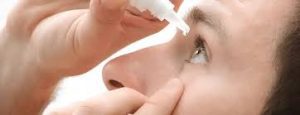
The mechanics matter because the wrong technique can displace the lens or introduce contamination. First, wash your hands thoroughly and dry on a clean towel. Confirm the drops are preservative-free and contact-safe. Tilt your head slightly back and look up; pull down the lower lid gently. Instil one drop — two at most — directly into the lower fornix, not onto the lens centre. Blink slowly a few times to distribute across the lens surface. Avoid touching the dropper tip to your lashes, the lens, or any surface. Our broader article on inserting and removing scleral lenses covers the full handling technique, and cleaning scleral lenses covers end-of-day care.
Signs You Need to Reach for Drops
Scleral wearers quickly learn the cues that mean add moisture. Watch for lens fogging — the reservoir has concentrated and needs refreshing. Mild blurring that clears briefly with a blink often points to surface dryness. Gritty or scratchy sensation, especially in the afternoon, signals tear film depletion outside the lens. Increased awareness of the lens edge is often the first sign. Reaching for drops proactively — before the symptom becomes obvious — is the habit that separates comfortable long-day wearers from those who struggle. Dry eye symptoms are worth knowing in detail since many scleral patients have underlying ocular surface disease alongside their corneal condition.
Conclusion
Scleral lenses are one of modern optometry’s most elegant interventions for challenging corneal conditions, and the drops you pair with them are inseparable from the wearing experience. Preservative-free saline for the reservoir, contact-safe preservative-free lubricating drops for comfort during wear, appropriate thick gels after removal, and prescription drops only under clinician instruction — that is the entire framework. For a personalised scleral-lens fitting and drop regimen tailored to your specific corneal condition, book a consultation at Visual Aids Centre’s scleral lens clinic.
Frequently Asked Questions (FAQs)
Can I put regular eye drops over my scleral lenses?
Only if they are labelled contact-safe and preservative-free. Regular over-the-counter drops often contain preservatives or oils that cloud sclerals or irritate the ocular surface with chronic use.
Why do I need preservative-free saline in the reservoir?
Because the saline sits against your cornea all day. Preservatives like benzalkonium chloride accumulate in the sealed space and cause progressive ocular surface toxicity.
Can I use redness-reducing drops with scleral lenses?
No. Vasoconstrictor drops mask symptoms, can worsen eye health long-term, and are incompatible with chronic scleral wear. Address the underlying cause of redness instead.
Are thick gels safe with scleral lenses?
Only after removing your lenses — typically at bedtime. During wear they cause blurring and cling to the lens surface.
Can I use prescription drops with my sclerals in?
Sometimes, but only on your clinician’s specific instruction. Compatibility depends on the preservative system and intended pharmacology of the medication.
Is it safe to use distilled water to fill the reservoir?
No. Water of any type — distilled, tap, or bottled — is unsafe in the reservoir because it is not isotonic and can carry Acanthamoeba. Use FDA-cleared preservative-free saline only.
👁️ MEDICALLY REVIEWED BY
Padmashree Dr. Vipin Buckshey
Optometrist & Specialty Contact Lens Consultant | AIIMS Graduate, 1977 | Padma Shri Honouree
Scleral lens fitting is one of optometry’s most technically demanding disciplines, and drop protocols are inseparable from lens-wearing success. Dr. Vipin Buckshey and the Visual Aids Centre specialty contact lens team fit sclerals for patients with keratoconus, post-LASIK ectasia, severe ocular surface disease, and other challenging corneal conditions — with a personalised drop regimen issued alongside every lens. An AIIMS alumnus, former President of the Indian Optometric Association, official optometrist to the President of India, and Padma Shri recipient, Dr. Buckshey founded Visual Aids Centre in 1980, and the clinic has offered advanced contact lens services continuously since. Read more in our story.