
You had LASIK eye surgery a few days ago, your daytime vision feels sharper than it has in years, and then you step outside at night — and headlights explode into dramatic starbursts, streetlights develop glowing rings, and car indicators seem to trail wildly across the road. If this sounds familiar, you are experiencing one of the most common early post-LASIK visual phenomena, and the good news is that it is almost always temporary.
Light bursts after LASIK are not a complication in the classical sense — they are a predictable optical side effect tied to how your pupil interacts with the laser-treated zone of your cornea in low light. This guide from Visual Aids Centre explains exactly why it happens, how long it lasts, what factors make it worse, and the specific signs that mean you should call your surgeon rather than wait it out.
Key Takeaways
- Light bursts (starbursts) after LASIK occur when your pupil in low light dilates wider than the laser-treated optical zone, scattering light at the edges.
- Most patients see significant improvement within 2–4 weeks and complete resolution by 3 months as the cornea settles and higher-order aberrations reduce.
- Patients with naturally large pupils or high prescriptions are more likely to experience noticeable bursts in the early weeks.
- Persistent light bursts beyond 3 months warrant a wavefront evaluation and may benefit from a topography-guided enhancement.
What Are Light Bursts After LASIK?
Light bursts — also called starbursts — are the dramatic ray-like projections that seem to radiate outward from point light sources at night. They are distinct from halos (concentric rings around lights) and glare (generalised scatter), though many patients experience all three together in the early recovery period. Starbursts tend to be most pronounced when driving at night, looking at streetlamps, or seeing car headlights on a dark road.
These phenomena belong to a broader category called higher-order aberrations — optical imperfections beyond simple refractive error that affect how light focuses on the retina. LASIK corrects the lower-order aberrations (sphere and cylinder) that blur your vision, but it can temporarily introduce or amplify higher-order aberrations during the first few months of corneal remodelling. For a technical look at how surgeons measure these, our article on Zernike polynomials explains the mathematical framework.
Why Light Bursts Happen — The Pupil-Optical Zone Mismatch
This is the key concept most patients never hear explained clearly. Your pupil is the opening that lets light into your eye. In bright conditions, it constricts to 2–3 mm. In dim or dark conditions, it dilates — sometimes to 6, 7, or even 8 mm in younger patients.
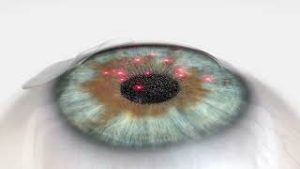
During LASIK, the laser reshapes a central zone of your cornea called the optical zone — typically 6 to 6.5 mm in diameter. Light passing through this zone is refracted precisely onto the retina. But in very dim conditions, when your pupil dilates beyond the edge of the treated zone, some light enters through the untreated peripheral cornea. This peripheral light hits the transition between the reshaped central zone and the natural peripheral cornea — and scatters.
The scatter pattern, diffracted by the edge of the treatment, produces the starburst appearance. It is not a defect in the surgery itself — it is a predictable optical consequence of the pupil temporarily being larger than the zone of correction. As the cornea heals, the edge transition smooths out and the brain also adapts to filter the residual scatter. This is why pupil size assessment is a critical part of the pre-operative workup.
How Long Do Light Bursts Last?
For most patients, the timeline looks like this. In the first 1 to 2 weeks, starbursts are at their most pronounced — largely because residual corneal swelling amplifies the scatter at the optical zone edge. From weeks 3 to 8, noticeable reduction occurs as the swelling resolves, the flap settles, and the cornea smooths. By the 3-month mark, 85% of patients report that starbursts have either resolved completely or reduced to a level that no longer interferes with daily life. A small percentage — roughly 3 to 5% — may continue to notice mild starbursts at night for 6 to 12 months, typically fading gradually. For context on timelines, our article on how long halos last covers the related but distinct phenomenon.
Who Is More Likely to See Them?
Several factors increase the likelihood and intensity of post-LASIK light bursts. Patients with naturally large scotopic (dark-adapted) pupils are at highest risk — if your pupil dilates to 7 mm or more in dim conditions but your optical zone is only 6.5 mm, there is simply more peripheral light entering the eye where scatter can occur. High-prescription patients also experience more pronounced bursts because the cornea has been reshaped more aggressively, creating a steeper transition at the edge of the treatment zone.
Younger patients tend to have larger pupils and more reactive dilation responses, which is why a 25-year-old may notice starbursts more than a 45-year-old with identical surgery. Dry eye post-surgery also amplifies the perception of starbursts because an unstable tear film scatters incoming light further — which is why night vision recovery is closely tied to managing ocular surface health in parallel.
How to Manage Light Bursts During Recovery
While you wait for the cornea to finish settling, several practical strategies genuinely help. Keep your eyes well-lubricated with preservative-free drops throughout the day and especially before night-time driving — a stable tear film reduces light scatter immediately. Avoid driving at night for the first 1 to 2 weeks when bursts are most dramatic; if you must drive, stick to well-lit main roads rather than dim side streets.
Anti-reflective coatings on any glasses you still wear (for residual astigmatism, for instance) meaningfully reduce night-time visual disturbances. If starbursts are particularly disruptive, your surgeon may consider pupil-constricting drops for occasional use in challenging light conditions — but only under direct medical supervision. Avoid self-treating. Our article on improving night vision after LASIK covers the full toolkit of strategies.
When Light Bursts Do Not Go Away
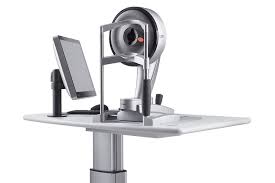
If bursts remain disruptive beyond 3 months, a thorough evaluation is warranted. Your surgeon will perform wavefront analysis to measure the specific pattern of higher-order aberrations in your eye. In some cases, a topography-guided enhancement — essentially a refined second laser treatment — can smooth the optical zone transition and substantially reduce symptoms. This is relatively uncommon, but it is available for patients whose symptoms do not resolve naturally.
Persistent, severe bursts can also occasionally indicate other issues such as residual refractive error, mild dry eye, or decentration of the original ablation. A full post-op review identifies which factor is driving the symptoms and guides the appropriate response. Patients experiencing unusual visual phenomena alongside bursts should read our guide on unusual visual perceptions after LASIK for context.
Conclusion
Light bursts after LASIK are a normal, temporary consequence of the pupil dilating beyond the laser-treated optical zone in low light. The vast majority of patients see dramatic reduction within the first month and full resolution within 3 months. If bursts persist meaningfully beyond that, specialised evaluations and treatment options exist. If you are planning LASIK eye surgery in Delhi and want a detailed pupil and corneal assessment, or if you are months post-LASIK and still troubled by starbursts, book a consultation at Visual Aids Centre for expert evaluation.
Frequently Asked Questions (FAQs)
Are light bursts after LASIK permanent?
In most cases, no. They improve significantly within 2 to 4 weeks and resolve completely for the majority of patients by 3 months. Persistent bursts beyond 6 months are uncommon and usually treatable.
What is the difference between a halo and a starburst after LASIK?
Halos are concentric rings around lights; starbursts (light bursts) are dramatic ray-like projections. Both result from light scatter but have slightly different optical causes.
Why are my light bursts worse at night than during the day?
Your pupil dilates wider in low light, extending beyond the laser-treated optical zone. More peripheral light entering the eye creates more scatter and more visible bursts.
Can I drive at night with light bursts after LASIK?
Short answer: use caution. Most surgeons advise avoiding night driving for the first 1 to 2 weeks. After that, you can drive if you feel confident, but well-lit routes are safer initially.
Do larger pupils always mean more starbursts?
Not always, but patients with scotopic pupils larger than the optical zone (typically over 6.5–7 mm) are at higher risk. Modern topography-guided procedures have minimised this concern significantly.
When should I worry about persistent light bursts?
If starbursts remain severe and disruptive beyond 3 months, or are accompanied by worsening vision, pain, or redness, schedule an evaluation with your surgeon promptly.
👁️ MEDICALLY REVIEWED BY
Padmashree Dr. Vipin Buckshey
Optometrist & Refractive Surgery Specialist | AIIMS Graduate, 1977 | Padma Shri Honouree
With more than four decades of clinical experience and over 250,000 laser vision correction procedures performed at Visual Aids Centre, Dr. Vipin Buckshey has guided patients through every stage of post-LASIK visual adaptation — including the early starburst phase and the rare persistent aberration cases. An AIIMS alumnus, former President of the Indian Optometric Association, and official optometrist to the President of India, Dr. Buckshey ensures every post-operative query receives a precise, evidence-based answer. Learn more about our story.