It’s one of the most common concerns people raise before committing to LASIK: “Will I be able to read my phone afterwards?” or “My colleague got LASIK and now needs reading glasses — will that happen to me?” The short answer is that LASIK itself doesn’t damage your ability to see up close. But there’s an important nuance — and it’s one that every prospective patient over 35 should understand before scheduling surgery.
The confusion arises because LASIK corrects your distance vision by reshaping the cornea, but it doesn’t stop or reverse the natural age-related stiffening of your eye’s internal lens — a process called presbyopia — that eventually affects everyone’s near vision. For younger patients, LASIK has no impact on close-up sight. For patients approaching or past their early 40s, correcting distance vision to perfection can unmask a reading difficulty that was previously hidden by their glasses prescription. This guide explains exactly why that happens, who is affected, and the strategies — including monovision LASIK and blended-vision techniques — that preserve both distance and near sight after surgery.
Key Takeaways
- LASIK does not damage your near vision — it corrects distance vision, which can reveal the natural age-related loss of close-up focus (presbyopia).
- Patients under 40 with stable prescriptions rarely notice any change in reading ability after LASIK.
- Patients over 40 may need reading glasses after LASIK, but this would have happened with or without the surgery.
- Monovision LASIK and blended-vision techniques can reduce or eliminate the need for reading glasses at any age.
How Near Vision Works — And What Changes With Age
To understand whether LASIK affects close vision, you first need to understand how your eye focuses on nearby objects. Inside your eye, behind the iris, sits a flexible crystalline lens. When you look at something close — a book, a phone, a menu — the ciliary muscle contracts and this lens changes shape, increasing its curvature to bring the near object into sharp focus. This process is called accommodation.
Accommodation works effortlessly in your teens and twenties. But starting around age 40, the crystalline lens gradually loses its flexibility. It becomes stiffer, less able to change shape on demand. By your mid-40s, most people notice they need to hold reading material farther away to see it clearly. By 50, almost everyone needs some form of near-vision correction. This process — presbyopia — is a universal, age-driven change in the lens inside the eye. It has nothing to do with the cornea, and nothing to do with LASIK.
What LASIK Actually Does to Your Vision
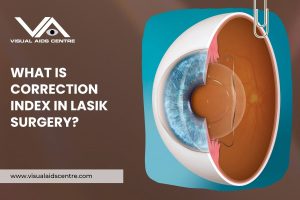
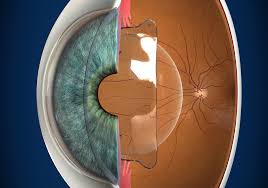
LASIK reshapes the cornea — the clear front surface of your eye — to correct refractive errors like myopia (short-sightedness), hyperopia (far-sightedness), and astigmatism. It works on the cornea only. It does not touch, alter, or affect the crystalline lens inside the eye that controls near focus. So in a direct, mechanical sense, LASIK does not “mess up” close vision — it simply isn’t operating on the part of the eye responsible for near focus.
What LASIK does do, and does extremely well, is give you clear distance vision without glasses or contact lenses. For patients with myopia, this means the cornea is flattened slightly; for hyperopia, it’s steepened. Either way, the goal is a cornea that focuses distant light precisely onto the retina — and that’s exactly where the near-vision conversation begins.
Why Close Vision Can Seem Worse After LASIK
The “Unmasking” Effect in Myopic Patients
Here’s the nuance that trips people up. If you’ve been short-sighted your whole life, your uncorrected eyes naturally focus at a close distance — that’s what myopia means. When you take your glasses off, you can read comfortably without any effort from the crystalline lens. Your myopia, in a sense, has been giving you a built-in reading advantage.
When LASIK corrects your myopia and gives you clear distance vision, that built-in near-focus advantage disappears. Your eyes now focus at distance by default — exactly like a person who never needed glasses. If you’re under 40 and your crystalline lens is still flexible, accommodation kicks in seamlessly and you won’t notice any difference. But if you’re over 40 and presbyopia has already begun reducing your lens flexibility, you may suddenly find that reading a book or menu requires more effort — or reading glasses.
This isn’t LASIK damaging your near vision. It’s LASIK revealing the presbyopia that your myopia was previously compensating for. The same thing would happen if you switched from glasses to contact lenses that fully corrected your distance vision.
Temporary Close-Focus Issues During Recovery
It’s also worth noting that in the first few weeks after LASIK, many patients — regardless of age — experience mild difficulty with close focus. This is caused by temporary corneal swelling, fluctuating tear film, and the visual system adjusting to its new prescription. Close-range eye strain during this period is normal and resolves as healing progresses. If your computer screen seems blurry in the first month, this is almost certainly temporary — not a permanent change in near vision.
Who Is Most Likely to Notice a Change?
Patients Over 40
The strongest predictor is age. If you’re over 40 and having LASIK for myopia, your surgeon should discuss the near-vision trade-off in detail before surgery. The higher your pre-surgery myopia, the more noticeable the shift will be — because the larger your built-in reading advantage, the more you’ll miss it once it’s corrected. Understanding the best age for LASIK and how presbyopia factors into the decision is essential for realistic expectations.
Patients in Their Late 30s
If you’re 37–39, you’re at the threshold. Your crystalline lens is already losing flexibility, though you may not have noticed yet. LASIK at this age gives you excellent distance vision, but you may find that within 2–3 years, reading tasks become slightly harder than they were before. This isn’t LASIK regression — it’s presbyopia progressing on its natural timeline. For more on how LASIK outcomes interact with ageing, understanding this distinction prevents unnecessary worry.
Patients Under 35
If you’re under 35 with a stable prescription, LASIK is extremely unlikely to affect your near vision in any noticeable way. Your crystalline lens has plenty of accommodative reserve, and you’ll be able to switch between distance and near focus without effort — just like someone with naturally perfect vision.
Solutions That Preserve Near Vision After LASIK
Monovision LASIK
The most established approach for patients concerned about near vision is monovision — where your dominant eye is corrected for distance and your non-dominant eye is deliberately left slightly myopic (typically -1.00 to -1.50 dioptres) to handle close tasks. Your brain learns to prioritise the appropriate eye for each viewing distance. Monovision isn’t for everyone — some patients find the difference between the two eyes uncomfortable — which is why a trial with contact lenses before surgery is standard practice. But for patients who adapt well, monovision provides functional vision at all distances without glasses.
Blended Vision
A refinement of monovision, blended-vision techniques use advanced corneal profiling to create a smooth transition between the distance eye and the near eye, reducing the visual compromise that some patients feel with traditional monovision. The result is a more natural visual experience across all ranges.
Reading Glasses After LASIK
For patients who want both eyes corrected fully for distance — and many do — the simplest near-vision solution is a pair of inexpensive reading glasses for close tasks. Many patients find this a perfectly acceptable trade-off: clear, glasses-free distance vision for driving, sport, and daily life, with lightweight readers for prolonged reading or detailed work. Your surgeon will discuss this at your pre-LASIK consultation so you know exactly what to expect before committing.
Future Options
If presbyopia progresses significantly in the years following LASIK, additional options exist. Presbyopia-correcting strategies continue to evolve, and your surgeon can advise on the most suitable approach based on your corneal health, remaining prescription, and lifestyle needs at the time.
Conclusion
LASIK doesn’t mess up your close vision — it doesn’t operate on the part of the eye responsible for near focus. What it can do, particularly for myopic patients over 40, is unmask the natural presbyopia that your short-sightedness was previously compensating for. For younger patients, near vision remains unaffected. For patients approaching or past 40, strategies like monovision LASIK, blended vision, or simple reading glasses keep both distance and close sight sharp. The key is an honest, detailed conversation with your surgeon before surgery so you understand exactly how your age and prescription interact with the outcome. If you’d like a personalised assessment of how LASIK would affect your near vision, book a consultation at Visual Aids Centre — our team will walk you through every scenario specific to your eyes.
Frequently Asked Questions (FAQs)
Will I need reading glasses after LASIK?
If you’re under 40, almost certainly not. If you’re over 45, reading glasses for close work are likely regardless of whether you have LASIK — presbyopia affects everyone. Monovision LASIK can reduce or eliminate this need.
Does LASIK cause presbyopia?
No. Presbyopia is caused by the natural stiffening of the crystalline lens inside the eye with age. LASIK only reshapes the cornea and has no effect on this lens. It can, however, unmask presbyopia that myopia was previously compensating for.
Can monovision LASIK give me clear vision at all distances?
For most daily tasks, yes. One eye handles distance, the other handles near, and the brain blends the input. A contact lens trial before surgery confirms whether monovision works well for you.
I’m 38 — should I wait to get LASIK because of presbyopia?
Not necessarily. You’ll enjoy many years of clear distance vision, and if near-vision changes develop in your mid-40s, they can be addressed at that point with reading glasses or an enhancement. Your surgeon can help you weigh the timing.
Why could I read without glasses before LASIK but not after?
If you were myopic, your uncorrected eyes naturally focused at a close distance. Correcting that myopia with LASIK shifts your default focus to distance — revealing any presbyopia that was previously hidden by the short-sightedness.
Is blurry close vision in the first week after LASIK permanent?
No. Temporary difficulty with close focus is common during early recovery due to corneal swelling and tear film instability. It typically resolves within 2–4 weeks as healing progresses.
👁️ MEDICALLY REVIEWED BY
Padmashree Dr. Vipin Buckshey
Optometrist & Post-Operative Care Specialist | AIIMS Graduate, 1977 | Padma Shri Honouree
With more than four decades of clinical experience and over 250,000 laser vision correction procedures performed at Visual Aids Centre, Dr. Vipin Buckshey has counselled thousands of patients on the relationship between LASIK, presbyopia, and near-vision expectations — helping them choose the right strategy for their age, prescription, and lifestyle. An AIIMS alumnus, former President of the Indian Optometric Association, and official optometrist to the President of India, Dr. Buckshey ensures every patient understands exactly what to expect before, during, and after the procedure. Learn more about our story.