If you’ve been wearing toric contact lenses to correct cylindrical power—what your optometrist calls astigmatism—you’ve probably wondered whether LASIK could free you from lenses altogether. The short answer is: yes, in most cases, people who wear cylindrical power contacts are excellent LASIK candidates.
But the details matter. The amount of cylindrical power you have, the shape and thickness of your cornea, and whether your prescription has been stable all play a role in determining eligibility. In this article, we’ll break down exactly what cylindrical power means, how LASIK corrects it, where the limits lie, and which laser procedures are best suited for astigmatism correction.
Key Takeaways
- Most people who wear toric contact lenses for cylindrical power are suitable LASIK candidates.
- LASIK can correct both spherical and cylindrical power in a single treatment.
- Most LASIK platforms can treat astigmatism up to about –6.00 D.
- Corneal thickness, corneal shape, and prescription stability are critical before surgery.
What Is Cylindrical Power and Why Does It Require Special Lenses?
Cylindrical power corrects astigmatism—a condition where the cornea, or sometimes the lens inside the eye, is shaped more like a rugby ball than a perfectly round sphere. Instead of bending light evenly, an astigmatic cornea focuses light at two different points, causing blurred or distorted vision at all distances.
Standard spherical contact lenses can’t fix this because they have uniform curvature. That’s why you need toric lenses—contacts designed with different focusing powers along different meridians of the lens. They sit on the eye in a specific orientation, which is why toric lenses sometimes rotate and blur your vision momentarily.
On your prescription, cylindrical power appears as the “Cyl” value alongside an “Axis” number that tells the lens which direction to correct. If you’re tired of dealing with lens rotation, dryness, and the daily hassle of toric contacts, LASIK offers a permanent alternative.
Can LASIK Actually Correct Cylindrical Power?
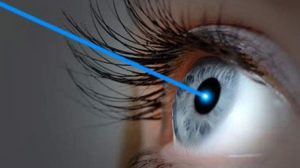
Absolutely. LASIK is one of the most effective treatments for astigmatism. During the procedure, the excimer laser reshapes the cornea to eliminate the uneven curvature that causes cylindrical error. Unlike a toric contact lens that compensates for the irregularity from outside, LASIK permanently corrects the corneal surface itself.
Modern LASIK platforms use wavefront-guided or topography-guided profiles that map your cornea’s unique irregularities in extraordinary detail. This means the laser doesn’t just correct generic cylindrical power—it addresses the specific pattern of your astigmatism with micron-level precision.
What Is the Maximum Cylindrical Power LASIK Can Correct?
Most FDA-approved LASIK platforms can correct astigmatism up to about –6.00 dioptres of cylindrical power. In practice, the majority of patients fall well within this range.
- Up to –2.00 D cylinder: Straightforward LASIK correction with excellent predictability.
- –2.00 to –4.00 D cylinder: Still highly treatable, though your surgeon will pay closer attention to corneal thickness and regularity.
- –4.00 to –6.00 D cylinder: LASIK is possible, but it requires detailed pre-operative evaluation. Alternatives like SMILE Pro or Toric ICL may also be discussed.
- Above –6.00 D cylinder: LASIK alone may not be sufficient, and an implantable lens or another customised approach may be recommended.
Learn more in our related guide on what is the LASIK astigmatism limit.
Important Pre-LASIK Requirements for Contact Lens Wearers
Stop Wearing Contacts Before Your Evaluation
This step is non-negotiable and especially important for toric lens wearers. Contact lenses—particularly toric and rigid gas permeable types—temporarily reshape the cornea. If you go for your LASIK consultation while still wearing lenses, your corneal measurements will be inaccurate, leading to unreliable surgical planning.
The standard recommendation is to stop wearing soft toric contacts at least 1–2 weeks before your pre-operative assessment. If you wear rigid or hybrid lenses, your surgeon may ask you to switch to glasses for 3–4 weeks or even longer.
For full guidance, see how long before LASIK should you stop wearing contacts.
Corneal Thickness and Shape Must Qualify
LASIK works by removing a precise amount of corneal tissue. Higher cylindrical corrections require more tissue removal, so adequate corneal thickness is essential. Your surgeon will use pachymetry and corneal topography to confirm that enough tissue remains after correction to maintain structural integrity.
If corneal thickness is a concern, explore what if my cornea is too thin for LASIK.
Your Prescription Must Be Stable
LASIK is designed for people whose prescription has remained consistent for at least 12 months. If your cylindrical power is still changing, your surgeon will advise waiting until it stabilises—otherwise, the correction could become partially outdated as your eyes continue to shift.
Which Laser Procedure Is Best for Astigmatism?
While standard LASIK handles most astigmatism cases beautifully, some patients may benefit from more tailored approaches:
- Contoura Vision: A topography-guided LASIK platform that maps thousands of elevation points on the cornea. Particularly effective for irregular astigmatism.
- SMILE / SMILE Pro: A flapless, keyhole procedure that can correct astigmatism up to around –5.00 D and is appealing for patients with active lifestyles.
- PRK / TransPRK: A surface ablation procedure suited for patients with thinner corneas who still want laser correction.
- Toric ICL: An implantable collamer lens option for patients with very high cylindrical power who aren’t suitable for corneal laser procedures.
Can Astigmatism Return After LASIK?
In the vast majority of cases, astigmatism corrected by LASIK stays corrected. The corneal reshaping is permanent. However, a small percentage of patients—particularly those with higher initial cylindrical power—may experience minor regression over time. This is typically less than 0.50 D and often doesn’t require retreatment.
If meaningful regression does occur, an enhancement procedure can usually address it, provided sufficient corneal tissue remains.
Read more about this at can astigmatism come back after LASIK.
Why Patients With Cylindrical Power Choose Visual Aids Centre
Visual Aids Centre has been correcting astigmatism with laser vision technology since 1999—longer than any other private practice in Delhi. Under the clinical leadership of Padmashree Dr. Vipin Buckshey, our team offers the full spectrum of astigmatism correction options, from Contoura Vision and SMILE Pro to Toric ICL, ensuring every patient receives the procedure best matched to their corneal anatomy and visual goals.
Ready to find out if LASIK can replace your toric contacts? Book your consultation today.
Conclusion
If you’re wearing toric contact lenses for cylindrical power, you’re very likely a potential LASIK candidate. The procedure corrects astigmatism permanently by reshaping the cornea—eliminating the need for lenses that rotate, dry out, and require daily maintenance.
The key is a thorough pre-operative assessment: stop wearing contacts well in advance, confirm adequate corneal thickness, and ensure your prescription is stable. With the right evaluation, LASIK can give you the clear, lens-free vision you’ve been working around.
Frequently Asked Questions (FAQs)
Do I need to tell my LASIK surgeon I wear toric lenses?
Yes. Toric lenses reshape the cornea more than regular contacts. Your surgeon needs this information to set the correct contact lens discontinuation period and get accurate corneal measurements.
Is LASIK more risky for people with astigmatism?
No. LASIK for astigmatism carries the same safety profile as LASIK for myopia or hyperopia. Success rates for cylindrical correction are consistently very high when patients are properly screened.
Can LASIK fix both my spherical and cylindrical power at the same time?
Yes. LASIK corrects your entire refractive error—sphere, cylinder, and axis—in a single procedure. There’s no need for separate treatments.
What if my cylindrical power is too high for LASIK?
If your astigmatism exceeds what LASIK can safely correct, alternatives like SMILE Pro or Toric ICL may be recommended.
How soon after stopping toric contacts can I have LASIK?
For soft toric lenses, plan on 1–2 weeks without lenses before your evaluation. RGP or hybrid lens wearers may need 3–4 weeks or more.
👁️ EXPERT AUTHOR & CLINICAL DIRECTOR
Padmashree Dr. Vipin Buckshey
Chief Optometrist & Refractive Surgery Specialist | Padma Shri Recipient | AIIMS Graduate (1977)
Dr. Vipin Buckshey has spent over forty years transforming how India approaches refractive eye care. As the founder of Visual Aids Centre—established in 1980 and home to Delhi’s very first private LASIK suite since 1999—he has overseen more than 250,000 laser vision correction procedures, including thousands of astigmatism-specific treatments using Contoura Vision, SMILE Pro, and toric ICL technologies.
Recognised with the Padma Shri for his outstanding contribution to Indian eye care, Dr. Buckshey also holds the distinction of serving as the official optometrist to the President of India. A past President of the Indian Optometric Association and a sought-after speaker at global refractive surgery forums, he brings unmatched depth of experience to every patient consultation.