You passed all your pre-LASIK tests, the surgery went smoothly, and your prescription is now zero — yet you notice halos around headlights, starbursts from streetlamps, or a subtle haze that glasses cannot fix. These visual disturbances are often caused by high-order aberrations (HOAs), a category of optical imperfections that standard lenses cannot correct because they involve complex irregularities in how light bends through your cornea.
The good news: HOAs after LASIK are far less common with modern laser platforms than they were a decade ago, and when they do occur, they are usually mild and manageable. This guide explains what high-order aberrations are, why LASIK can introduce them, how your surgeon diagnoses them, and what treatment options are available at Visual Aids Centre. If you are experiencing persistent glare or halos and want to understand whether they fall within the normal recovery arc, our article on how long halos last after LASIK covers the typical timeline.
Key Takeaways
- High-order aberrations are complex optical distortions — like coma, trefoil, and spherical aberration — that cannot be corrected with standard glasses or contacts.
- LASIK can introduce HOAs by altering corneal curvature, especially at the transition zone between treated and untreated tissue.
- Patients with larger pupils, higher prescriptions, or thinner corneas face a slightly elevated risk of post-LASIK HOAs.
- Wavefront-guided and topography-guided LASIK platforms significantly reduce HOA risk compared to conventional treatments.
What Are High-Order Aberrations?
Every eye has optical imperfections called aberrations. Lower-order aberrations — myopia, hyperopia, and astigmatism — account for roughly 85% of all refractive errors and are what standard glasses, contacts, and conventional LASIK correct. High-order aberrations make up the remaining 15% and involve more complex distortions in the way light passes through the cornea and lens.
The most clinically relevant HOAs include spherical aberration (causes haze and reduced contrast, especially in dim light), coma (produces comet-like tails on point light sources), and trefoil (creates a three-pointed distortion pattern). These aberrations are described mathematically using Zernike polynomials — a classification system that maps each type of distortion across the corneal surface. While everyone has some baseline level of HOAs, problems arise when LASIK increases them beyond the eye’s natural tolerance.
Symptoms of HOAs After LASIK
Patients experiencing elevated high-order aberrations after LASIK typically report visual disturbances that are most noticeable in low-light conditions — precisely when the pupil dilates and light passes through the peripheral cornea where irregularities tend to concentrate. Common symptoms include halos or rings around lights (especially noticeable while driving at night), starbursts radiating from point light sources, reduced contrast sensitivity (difficulty distinguishing shapes against similar-toned backgrounds), ghosting or faint double images, and an overall “soft” quality to vision despite having 20/20 acuity on the chart.
These symptoms can be frustrating because your standard eye test may show excellent visual acuity — the letters are sharp — but your subjective experience of vision quality feels diminished. If you are experiencing persistent night vision issues, our guide on whether LASIK can affect night vision explains the mechanisms and when to expect improvement. For patients dealing with ghosting specifically, fixing ghosting after LASIK covers targeted solutions.
Why LASIK Can Cause High-Order Aberrations
Corneal Reshaping and the Transition Zone
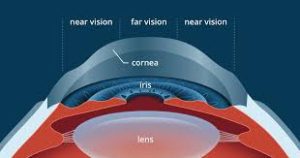
LASIK corrects vision by removing microscopic amounts of corneal tissue to change the eye’s focusing power. This creates a treatment zone (the corrected area) surrounded by a transition zone where the reshaped cornea blends into untreated tissue. If this transition is too abrupt or the treatment zone is too small relative to the pupil, light entering through the peripheral cornea bends differently from light entering the centre — producing spherical aberration and other HOAs. Understanding how LASIK reshapes the cornea at a structural level is explained in more detail in our article on corneal remodelling after LASIK.
Pupil Size
Patients with naturally large pupils (scotopic pupil diameter above 7 mm) are more susceptible to HOAs because their dilated pupil extends beyond the optical treatment zone in dim lighting. This is why thorough pupil size assessment is a critical part of pre-operative screening at Visual Aids Centre.
Higher Prescriptions
Correcting higher degrees of myopia or astigmatism requires removing more corneal tissue, which can create steeper curvature gradients in the transition zone. Patients with prescriptions approaching the upper limits of LASIK candidacy — typically above –8 diopters — face a statistically higher risk of measurable HOA increase. For these patients, SMILE Pro or Contoura Vision may offer a more aberration-friendly treatment profile.
Healing Response
Individual corneal healing is inherently variable. Some patients develop subtle epithelial irregularities or stromal remodelling patterns during recovery that introduce asymmetric aberrations. This biological variability is difficult to predict but is one reason post-operative monitoring during the first three to six months matters — mild HOAs that appear early often resolve as healing stabilises.
How HOAs Are Diagnosed
Standard refraction (the “better one or two?” test) cannot detect high-order aberrations — it only measures lower-order errors. Diagnosing HOAs requires specialised imaging technology.
Wavefront aberrometry is the gold standard: it sends a grid of light rays through the eye and measures how each ray is bent, producing a detailed aberration map that quantifies every type of distortion present. Corneal topography complements wavefront data by mapping the cornea’s surface curvature in fine detail, revealing any irregularities in shape that might be driving the aberrations. At Visual Aids Centre, we also assess pupil dynamics under different lighting conditions to correlate HOA measurements with the patient’s real-world symptoms — because an aberration that exists on paper may not be clinically significant if it falls outside the functional pupil zone.
Treatment and Management Options
Wavefront-Guided Enhancement
For patients with clinically significant HOAs, a wavefront-guided LASIK enhancement can be precisely targeted at the specific aberrations present. Unlike conventional LASIK, which only corrects sphere and cylinder, wavefront-guided treatments address each individual distortion mapped by aberrometry. This approach can substantially reduce HOAs and improve subjective visual quality, provided adequate corneal thickness remains for safe retreatment.
Specialty Contact Lenses
Rigid gas-permeable (RGP) lenses and scleral lenses create a smooth, uniform optical surface over the irregular cornea, effectively neutralising aberrations without further surgery. Scleral lenses for irregular corneas are particularly effective because they vault over the entire corneal surface and are filled with a fluid reservoir that masks irregularities.
Dry Eye Management
Dry eyes — one of the most common post-LASIK complaints — can temporarily worsen HOA symptoms by creating an uneven tear film that scatters light. Addressing dryness with proper dry eye treatment (preservative-free drops, punctal plugs, omega-3 supplementation) can meaningfully reduce glare and halos without any additional surgical intervention.
Time and Natural Healing
Many HOA symptoms peak in the first one to three months after LASIK and improve gradually as the cornea stabilises and nerve regeneration progresses. Surgeons at Visual Aids Centre typically advise waiting at least six months before considering enhancement surgery, allowing the eye’s natural healing process to resolve transient aberrations first.
Can High-Order Aberrations Be Prevented?
Modern LASIK platforms have dramatically reduced HOA risk compared to early-generation lasers. Several factors contribute to prevention: comprehensive pre-operative screening (including wavefront analysis, pupil assessment, and corneal thickness measurement via pachymetry), selection of an appropriately sized treatment zone that covers the patient’s scotopic pupil, use of wavefront-optimised or wavefront-guided ablation profiles that compensate for the spherical aberration inherent in corneal reshaping, and advanced eye-tracking systems that compensate for eye movements during the laser procedure.
At Visual Aids Centre, every LASIK patient undergoes a multi-point diagnostic workup before surgery precisely to identify HOA risk factors and select the laser platform and ablation profile best suited to their corneal anatomy.
Conclusion
High-order aberrations after LASIK are real but increasingly uncommon with today’s customised laser platforms. When they do occur, they are typically mild, often improve with time, and can be effectively managed with wavefront-guided enhancements, scleral lenses, or dry eye treatment. The key to minimising HOA risk lies in thorough pre-operative evaluation and selecting the right procedure for your corneal anatomy. If you are experiencing glare, halos, or reduced contrast after LASIK — or want to ensure your candidacy assessment accounts for HOA risk — book a consultation at Visual Aids Centre for a comprehensive wavefront and topographic evaluation.
Frequently Asked Questions (FAQs)
Are high-order aberrations after LASIK permanent?
Not necessarily. Many HOAs resolve or diminish within three to six months as the cornea heals. Persistent HOAs can be treated with wavefront-guided enhancement or specialty lenses.
Can glasses correct high-order aberrations?
No. Standard glasses only correct lower-order aberrations (myopia, hyperopia, astigmatism). HOAs require wavefront-guided laser treatment or rigid/scleral contact lenses.
Do all LASIK patients develop high-order aberrations?
All corneal reshaping introduces some measurable change in HOAs, but clinically significant aberrations that affect daily vision are uncommon with modern wavefront-optimised platforms.
Does pupil size affect HOA risk after LASIK?
Yes. Patients with larger pupils are more likely to experience HOA-related symptoms in low light because their dilated pupil extends beyond the laser treatment zone.
Which LASIK technique produces the fewest aberrations?
Wavefront-guided and topography-guided LASIK (such as Contoura Vision) produce fewer post-operative aberrations than conventional LASIK. Flapless procedures like SMILE Pro also show favourable HOA profiles.
👁️ MEDICALLY REVIEWED BY
Padmashree Dr. Vipin Buckshey
Optometrist & Refractive Surgery Specialist | AIIMS Graduate, 1977 | Padma Shri Honouree
With more than four decades of clinical experience and over 250,000 laser vision correction procedures performed at Visual Aids Centre, Dr. Vipin Buckshey has extensive expertise in diagnosing and managing post-LASIK optical aberrations using wavefront aberrometry and corneal topography. An AIIMS alumnus, former President of the Indian Optometric Association, and official optometrist to the President of India, Dr. Buckshey ensures every patient’s pre-operative workup includes comprehensive aberration mapping to minimise HOA risk and optimise visual quality outcomes. View full profile.