You’ve been told your eye power is “very mild”—maybe -0.50 or -0.75—and you’re wondering whether that’s even enough to qualify for LASIK. It’s a fair question. Most of the conversation around LASIK focuses on high prescriptions, but people with low powers are often just as frustrated by their dependence on glasses. So where exactly is the cut-off?
The answer isn’t a simple number. Whether LASIK makes sense for a low prescription depends on how much the power affects your daily life, your corneal measurements, and what your surgeon finds during the pre-operative evaluation. This guide from Visual Aids Centre explains the actual minimum thresholds, the clinical reasoning behind them, and when a mild prescription is—and isn’t—worth correcting surgically.
Key Takeaways
- Most LASIK platforms can technically correct prescriptions as low as -0.50 D (myopia), +0.50 D (hyperopia), or 0.50 D of astigmatism.
- The real question isn’t “can it be done?” but “should it be done?”—your surgeon weighs visual impact, corneal health, and lifestyle need.
- Low-power candidates still undergo the same comprehensive evaluation as high-power patients.
- Modern procedures like Contoura Vision can correct even subtle irregularities beyond the basic prescription number.
What Is the Minimum Eye Power for LASIK?
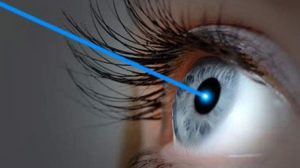
Technically, the excimer laser used in LASIK can correct prescriptions starting from approximately -0.50 dioptres for myopia (short-sightedness), +0.50 dioptres for hyperopia (long-sightedness), and 0.50 dioptres of cylindrical power (astigmatism). These are the lowest values most FDA-approved and CE-marked laser platforms are calibrated to treat.
In practical terms, this means there’s no hard minimum that disqualifies you purely based on a number. If your prescription falls anywhere within the treatable range—typically up to -8.00 D for myopia, +5.00 D for hyperopia, and up to 6.00 D of astigmatism—you’re within the technical capability of the laser. The question your surgeon is really asking is whether the amount of tissue removal required for your correction is clinically justified, given the inherent (though small) risks of any surgical procedure.
Why Is There a Minimum Prescription?
Every dioptre of correction requires a specific amount of corneal tissue to be reshaped by the excimer laser. For very low prescriptions, the amount of tissue removed is extremely small—sometimes just a few microns. While the laser handles this precisely, there are practical considerations that make surgeons think twice about very mild corrections.
First, the benefit-to-risk ratio matters. A person with -0.50 may not notice a meaningful visual improvement after surgery because their uncorrected vision is already quite functional. If the procedure introduces even temporary side effects like dry eye or mild halos at night, those could outweigh the benefit of correcting half a dioptre.
Second, there’s a concept called “regression”—the tendency for a small amount of correction to fade over the healing period as the cornea remodels. With very low corrections, even a slight regression could bring the patient close to their original prescription, making the surgery feel ineffective. Understanding what causes regression helps set realistic expectations for low-power patients.
LASIK for Low Myopia (-0.50 to -3.00)
Low myopia is the most common scenario where patients with mild prescriptions consider LASIK. At -1.00 to -3.00, most surgeons are comfortable recommending the procedure because the visual impact of uncorrected myopia at this level is noticeable—blurred road signs, difficulty watching a screen from across the room, and reliance on glasses for driving or lectures.
At -0.50 to -0.75, the decision becomes more nuanced. Some patients with very mild myopia function well without correction in most situations and only struggle in specific contexts (like night driving). For these individuals, the discussion shifts from “can we do LASIK” to “will the outcome make a meaningful difference in your daily life?” Your surgeon at Visual Aids Centre will spend time during the consultation understanding your visual demands—not just reading your prescription chart. For a broader understanding of low-power eligibility, see our detailed guide on whether LASIK can be done for low power.
LASIK for Low Hyperopia (+0.50 to +2.00)
Hyperopia (farsightedness) at low levels is trickier than myopia because the eye naturally compensates through accommodation—especially in younger patients. A 25-year-old with +1.00 may see clearly at all distances without glasses because their lens adjusts automatically. But this accommodation effort can cause eye strain, headaches, and fatigue—symptoms that glasses or LASIK both resolve.
The minimum threshold for hyperopic LASIK follows the same +0.50 D guideline, but surgeons tend to be more conservative. Hyperopic corrections involve steepening the cornea (rather than flattening it, as in myopia), and the healing dynamics differ. If you’re exploring correction for mild hyperopia, your evaluation will include tests for accommodation strength and whether your symptoms justify surgical intervention. For understanding the upper limits of hyperopic treatment, see hyperopic LASIK limits.
LASIK for Low Astigmatism (0.50 to 1.50 D)
Astigmatism occurs when the cornea is shaped more like a rugby ball than a basketball, causing blurred vision at all distances. Even half a dioptre of cylinder power can be visually noticeable—particularly at night, when pupils dilate and astigmatic blur becomes more pronounced. Low astigmatism is very effectively treated by LASIK, and the correction tends to be stable.
Topography-guided platforms like Contoura Vision are particularly well-suited for low astigmatism because they map and correct subtle corneal irregularities beyond what a standard refraction captures. Even patients with -0.50 cylinder who feel their vision is “not quite crisp” often see a noticeable improvement. If your astigmatism is the primary reason for considering surgery, read our overview on whether astigmatism patients qualify for LASIK.
When LASIK May Not Be Worth It for Low Powers
Surgeons sometimes advise against LASIK for very low prescriptions—not because the procedure is unsafe, but because the expected benefit may not justify the investment, recovery time, or temporary side effects. Scenarios where your surgeon might suggest waiting or skipping surgery include a prescription of -0.50 or less in both eyes with no significant visual complaints, a prescription that hasn’t been stable for at least 12 months (a sign that the power may still be changing), or a patient younger than 18–21 whose eyes haven’t finished developing.
In these cases, your surgeon isn’t refusing treatment—they’re protecting you from an outcome that might leave you feeling like the surgery didn’t do much. A responsible clinic will always prioritise your real-world visual experience over your prescription number.
What the Pre-Operative Evaluation Looks For
Whether your power is -0.75 or -7.50, the pre-surgical evaluation at Visual Aids Centre is the same comprehensive battery of tests. Your surgeon will assess corneal thickness (to ensure enough tissue remains after reshaping), corneal topography (to rule out irregular shapes like early keratoconus), pupil size (larger pupils may experience more glare after surgery), tear film quality (low-power patients with pre-existing dry eye may see more side effects than benefit), and retinal health (a dilated exam checks for conditions the prescription measurement alone wouldn’t reveal).
The Pentacam corneal scan is particularly important for low-power candidates because it confirms that the cornea is structurally sound—even when the prescription itself seems harmless. Thin corneas or suspicious topography patterns can disqualify even mild prescriptions from LASIK. In such cases, alternatives like SMILE Pro or TransPRK may be discussed.
Alternatives for Very Low Prescriptions
Contoura Vision
For patients with low refractive errors combined with subtle corneal irregularities, Contoura Vision offers a topography-guided treatment that goes beyond the basic prescription. It’s excellent for people who feel their vision is “almost perfect but not quite” even with glasses—a sign that higher-order aberrations may be involved.
SMILE Pro
While SMILE Pro is primarily used for myopia and myopic astigmatism, its flapless design makes it appealing for patients who want correction without the flap-related considerations of LASIK. It currently treats myopia from -1.00 D upward, so it isn’t suitable for the very lowest prescriptions.
Staying with Glasses or Contact Lenses
This is a perfectly valid option. If your prescription is -0.50 and you only wear glasses for night driving, the cost and recovery of surgery may not align with your needs. A good surgeon will tell you this honestly—not push you toward a procedure you don’t need.
Conclusion
The minimum prescription for LASIK is approximately -0.50 D for myopia, +0.50 D for hyperopia, and 0.50 D for astigmatism—but the real threshold is clinical judgment, not a single number. Your surgeon weighs your visual complaints, corneal health, lifestyle, and prescription stability to decide whether the benefit of surgery outweighs the inherent trade-offs. At Visual Aids Centre, we perform the same thorough evaluation for mild prescriptions as we do for high ones, because eligibility is about far more than just the power on your glasses. If you’re unsure whether your prescription qualifies, book a consultation and let us give you a clear, personalised answer.
Frequently Asked Questions (FAQs)
Can I get LASIK for just -0.50 power?
Technically yes—the laser can correct -0.50 D. But your surgeon will assess whether the visual improvement justifies the procedure based on your symptoms, corneal health, and lifestyle needs.
Is there a minimum eye power required for LASIK?
The minimum treatable power is approximately -0.50 D (myopia), +0.50 D (hyperopia), or 0.50 D (astigmatism). Below this, the correction is too small for the laser to apply reliably.
Will LASIK work for very mild astigmatism?
Yes. Even 0.50 to 0.75 D of astigmatism can cause noticeable blur, especially at night. LASIK and Contoura Vision both correct low astigmatism effectively.
Is it worth getting LASIK for a low prescription?
It depends on how much the prescription impacts your daily life. If you rely on glasses for driving, sports, or professional work, even a low correction can make a significant difference. If you barely notice it, surgery may not be necessary.
What if my prescription is too low for LASIK?
If your power is below -0.50 D, your surgeon may recommend monitoring it over time, using glasses or contacts as needed, or exploring whether corneal irregularities (not just power) are contributing to your visual symptoms.
👁️ MEDICALLY REVIEWED BY
Padmashree Dr. Vipin Buckshey
Optometrist & Post-Operative Care Specialist | AIIMS Graduate, 1977 | Padma Shri Honouree
The eligibility guidance in this article reflects pre-operative assessment protocols developed across more than 250,000 laser vision correction procedures supervised by Dr. Vipin Buckshey at Visual Aids Centre. An AIIMS alumnus, former President of the Indian Optometric Association, and official optometrist to the President of India, Dr. Buckshey evaluates every candidate individually—including those with low prescriptions—to ensure surgery is recommended only when the expected benefit clearly justifies the procedure.