If you’ve been wearing glasses or contact lenses for years, the idea of waking up with clear, unaided vision sounds almost too good to be true. So the question most people ask before booking a LASIK consultation is straightforward: will I actually get 6/6 vision back?
The short answer is that the vast majority of LASIK patients do achieve 6/6 (equivalent to 20/20) vision or very close to it. Published clinical data consistently shows that over 90% of patients reach 6/6 after a single procedure, and many achieve even sharper results. But “most patients” isn’t “every patient,” and understanding the difference is key to setting realistic expectations. This guide from Visual Aids Centre explains what 6/6 vision actually means, who is most likely to achieve it after LASIK, and which factors can influence your personal outcome.
Key Takeaways
- Over 90% of LASIK patients achieve 6/6 (20/20) vision after surgery.
- 6/6 means you can see at 6 metres what a person with normal eyesight sees at 6 metres—it’s the clinical benchmark for “normal” distance vision.
- Your starting prescription, corneal thickness, age, and overall eye health all influence the final result.
- Some patients achieve better than 6/6—reaching 6/5 or even 6/4 after surgery.
What Does 6/6 Vision Actually Mean?
The term “6/6” comes from the Snellen visual acuity scale, which is the standard eye chart your optometrist uses during a vision test. The first number represents the distance (in metres) at which you’re standing from the chart—always 6 metres in the metric system. The second number represents the distance at which a person with normal eyesight could read the same line.
So 6/6 means you can read at 6 metres what a normally sighted person reads at 6 metres. It’s the widely accepted benchmark for “normal” or “perfect” distance vision. In the imperial system used in the US, the same measurement is expressed as 20/20 (feet instead of metres). If your current vision is, say, 6/36, it means you need to stand at 6 metres to read what a person with normal sight can read from 36 metres away—a significant difference that LASIK is specifically designed to correct.
Can LASIK Realistically Restore 6/6 Vision?
Yes—and the success rates are remarkably high. Across large-scale studies and clinical registries, more than 90% of LASIK patients achieve 6/6 uncorrected visual acuity after the procedure. At experienced, high-volume centres using modern laser platforms, that number often exceeds 95%. These aren’t aspirational figures; they reflect real-world outcomes across thousands of procedures.
What makes LASIK so effective is its precision. The excimer laser reshapes the cornea with micron-level accuracy, correcting the exact refractive error—myopia, hyperopia, or astigmatism—that caused your blurred vision in the first place. For patients whose eyes meet the eligibility requirements, the probability of achieving 6/6 or better is high. The procedure doesn’t just improve vision; for most people, it restores it to the level they experience with their best-corrected glasses.
Factors That Affect Whether You’ll Achieve 6/6
Your Starting Prescription
Lower refractive errors tend to produce sharper post-surgical outcomes. A patient with -2.00 dioptres of myopia has a statistically higher chance of reaching 6/6 than someone with -8.00 dioptres, simply because less corneal tissue needs to be removed. That said, even patients with high myopia around -9.00 can achieve excellent results when their corneal anatomy supports the correction. The key is matching the procedure to the prescription—your surgeon evaluates this during the pre-operative assessment.
Corneal Thickness and Shape
LASIK works by reshaping corneal tissue, so there must be enough tissue available to safely make the correction. Patients with thinner corneas may not be ideal candidates for standard LASIK, though alternative procedures like SMILE Pro or TransPRK can sometimes offer a solution. Corneal shape irregularities—detected through topography scans—also influence outcomes. A smooth, symmetrical cornea responds more predictably to the laser.
Age and Presbyopia
LASIK corrects the refractive error present at the time of surgery. For patients under 40, the results are typically straightforward—distance vision improves dramatically. However, patients over 40 need to understand that presbyopia (the age-related loss of near-focusing ability) is a separate condition that LASIK doesn’t reverse. You may achieve 6/6 for distance but still need reading glasses for close work. Strategies like monovision LASIK can help address both distances, though they involve a deliberate trade-off.
Pupil Size
Patients with unusually large pupils may experience halos or glare in low light after LASIK, which can affect their perception of visual quality even if their Snellen acuity measures 6/6. Modern laser platforms with larger optical zones have significantly reduced this issue, but it’s still a factor your surgeon will evaluate. Learn more about this at what is considered a large pupil for LASIK.
Overall Eye Health
Conditions like dry eye syndrome, early cataracts, keratoconus, or retinal problems can limit LASIK outcomes regardless of your refractive error. A thorough pre-operative evaluation—including corneal topography, pachymetry, tear film analysis, and retinal examination—identifies these issues before surgery. If a contraindication is found, your surgeon may recommend treating the underlying condition first or suggest an alternative procedure entirely.
Can You Get Better Than 6/6 Vision After LASIK?
Yes—and it happens more often than people expect. A significant proportion of LASIK patients achieve 6/5 (20/15) or even 6/4 (20/12.5) visual acuity after surgery. This means they can see details at 6 metres that a person with “normal” 6/6 vision would need to be closer to see. Advanced technologies like wavefront-guided and topography-guided treatments improve the chances of achieving these “super-vision” results by correcting not just your basic prescription but also the subtle optical irregularities (higher-order aberrations) that even glasses can’t address.
Which LASIK Procedure Gives the Best Visual Outcome?
All modern refractive procedures—Femto LASIK, Contoura Vision, SMILE Pro—are capable of delivering 6/6 vision. The differences lie in how they achieve it and which patients benefit most from each approach.
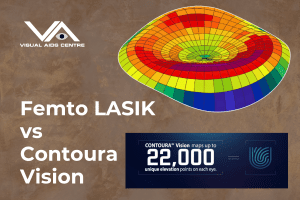
Contoura Vision, for instance, uses topographic data to create a treatment profile that’s customised to the unique surface of your cornea—not just your spectacle prescription. This often produces results that surpass what standard LASIK achieves. SMILE Pro, meanwhile, eliminates the need for a corneal flap entirely, preserving more structural integrity while still delivering comparable visual acuity.
The “best” procedure isn’t a one-size-fits-all answer. It depends on your prescription, corneal anatomy, lifestyle, and personal priorities.
When Does Vision Fully Stabilise After LASIK?
Most patients notice dramatically improved vision within 24 hours of LASIK. However, it’s common to experience mild fluctuations in clarity over the first few weeks as the cornea heals and the tear film restabilises. Final visual acuity typically stabilises within one to three months, though minor adjustments can continue for up to six months in some cases.
Don’t panic if your vision at the one-week mark isn’t perfectly crisp. The healing process is gradual, and temporary dryness or mild residual haze can affect day-to-day clarity before resolving completely. Your surgeon will track your progress through scheduled follow-ups at one day, one week, one month, and three months post-surgery.
What If You Don’t Reach 6/6 After LASIK?
A small percentage of patients—roughly 5–10%—may not achieve full 6/6 vision after the initial procedure. This doesn’t necessarily mean the surgery failed. In many cases, the result is 6/7.5 or 6/9, which is still a massive improvement over the pre-operative prescription and allows comfortable daily functioning without glasses.
If a clinically significant undercorrection or overcorrection remains after the cornea has fully healed (usually assessed at the three-month mark), an enhancement procedure—sometimes called a LASIK touch-up—can fine-tune the result. Enhancement rates vary by clinic and prescription range, but at experienced centres they’re typically needed in fewer than 5% of cases. Learn what an enhancement involves at how to know if you need a LASIK enhancement.
Conclusion
For the vast majority of eligible candidates, LASIK can absolutely restore 6/6 vision—and in many cases, surpass it. The procedure’s success rates are well-documented and consistently high, particularly when performed by experienced surgeons using current-generation laser platforms. Your personal outcome depends on factors like prescription strength, corneal health, and age, all of which are assessed during a comprehensive pre-operative evaluation. If you’re ready to find out whether 6/6 vision is realistic for your eyes, book a consultation at Visual Aids Centre and get a data-driven answer tailored to your specific anatomy.
Frequently Asked Questions (FAQs)
Is 6/6 vision the same as 20/20?
Yes. 6/6 uses metres (Snellen metric standard) while 20/20 uses feet (imperial). Both describe the same level of visual acuity—normal distance vision.
What percentage of LASIK patients achieve 6/6 vision?
Over 90% of patients achieve 6/6 or better after LASIK. At advanced clinics using topography-guided or wavefront-guided technology, the rate often exceeds 95%.
Can people with high myopia (-6 or above) get 6/6 after LASIK?
Many can, provided their corneal thickness and shape support the correction. Higher prescriptions have a slightly lower probability of reaching 6/6 compared to moderate prescriptions, but outcomes remain excellent for most patients.
Will I still need reading glasses after LASIK?
If you’re over 40, you may still need reading glasses due to presbyopia—an age-related condition LASIK doesn’t correct. Your distance vision can still reach 6/6. Monovision LASIK is one option to reduce dependence on readers.
How long does 6/6 vision last after LASIK?
LASIK produces permanent corneal reshaping, so the correction itself is lasting. However, age-related changes like presbyopia or, rarely, mild myopic regression can affect vision over the years. Most patients maintain excellent distance vision for decades.
👁️ MEDICALLY REVIEWED BY
Padmashree Dr. Vipin Buckshey
Optometrist & Vision Correction Specialist | AIIMS Graduate, 1977 | Padma Shri Honouree
The visual outcome benchmarks cited in this article are consistent with the clinical data tracked at Visual Aids Centre under the direct oversight of Dr. Vipin Buckshey. With over four decades of practice and more than 250,000 laser vision correction procedures supervised, Dr. Buckshey maintains detailed outcome registries that show 6/6 achievement rates well above 90% for eligible patients treated at the centre.
An AIIMS alumnus, former President of the Indian Optometric Association, official optometrist to the President of India, and Padma Shri recipient, Dr. Buckshey personally assesses every patient’s candidacy and selects the laser platform and treatment profile most likely to deliver optimal visual acuity based on their individual corneal anatomy and refractive profile.