
Yes — LASIK can effectively correct a negative eye number. If you have been wearing minus-powered glasses for nearsightedness and are wondering whether laser surgery can eliminate that prescription permanently, the answer for the vast majority of patients is a confident yes. LASIK reshapes the cornea to correct how light focuses on the retina, and for myopia (negative numbers), it has a success rate above 96% in achieving the target vision.
But “correct” and “cure” are different words, and that distinction matters. LASIK does not reverse the underlying elongation of the eyeball that causes myopia — it compensates for it by changing the cornea’s curvature. For most patients, this correction is permanent and life-changing. This guide explains how LASIK works for negative numbers, what power ranges are treatable, who qualifies, and what to realistically expect. If you are unsure whether your specific prescription falls within the treatable range, this article will clarify that too.
Key Takeaways
- LASIK corrects negative eye numbers (myopia) by flattening the steep cornea so light focuses directly on the retina instead of in front of it.
- Mild to moderate myopia (–1.00 to –6.00D) has the highest success rates — over 98% achieve 20/20 or better.
- High myopia (–6.00 to –8.00D) can also be treated, though outcomes depend on corneal thickness and pupil size.
- Very high prescriptions (beyond –8.00D) may be better suited to ICL rather than corneal laser surgery.
- LASIK does not stop myopia from progressing — your prescription must be stable for at least one year before surgery.
What Is a Negative Eye Number?
A negative eye number indicates myopia — commonly called nearsightedness or short-sightedness. It means the eyeball is slightly longer than normal, or the cornea is too steeply curved, causing light to focus in front of the retina rather than directly on it. The result is clear close-up vision but blurry distance vision.
Myopia severity is measured in dioptres (D) and written as a negative number on your prescription. Mild myopia ranges from –1.00 to –3.00D, moderate from –3.00 to –6.00D, and high myopia is anything beyond –6.00D. The higher your minus number, the thicker your glasses lenses and the greater your dependence on corrective eyewear. For patients wondering whether a specific power like –4.5 or –5.0 can be treated, our article on whether –4.5 power can be corrected covers that exact scenario.
How LASIK Corrects Myopia
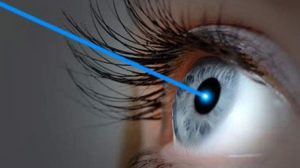
LASIK stands for Laser-Assisted In Situ Keratomileusis. The procedure corrects myopia in three steps. First, the surgeon creates a thin flap on the corneal surface using a femtosecond laser. Next, an excimer laser removes precisely calculated microscopic layers of corneal tissue to flatten the cornea’s central curvature. Finally, the flap is repositioned and heals naturally without stitches.
By flattening the steep cornea, LASIK changes the angle at which light enters the eye — shifting the focal point backward so it lands directly on the retina. The amount of tissue removed depends on your prescription: higher minus numbers require more tissue removal, which is why corneal thickness is a critical eligibility factor. The entire laser application takes less than 60 seconds per eye, and most patients notice dramatically improved vision within hours. For a deeper understanding of the corneal reshaping process, our guide on corneal biomechanics after LASIK explains the structural changes in detail.
Treatable Power Ranges
Mild Myopia: –1.00 to –3.00D
This is the sweet spot for LASIK. Patients with mild myopia require minimal tissue removal, which preserves more corneal structure and leaves a wide safety margin. Success rates in this range consistently exceed 99%, and most patients achieve 20/20 vision or better after a single procedure. Recovery is typically rapid, with functional vision returning within 24 hours.
Moderate Myopia: –3.00 to –6.00D
LASIK remains highly effective for moderate myopia, with success rates above 96%. The procedure requires somewhat more tissue removal, so your surgeon will evaluate corneal thickness carefully during the pre-operative corneal assessment. Patients with moderate myopia occasionally experience mild dry eye symptoms during the first few weeks of recovery, but these typically resolve with lubricating drops. The vast majority achieve spectacle independence permanently.
High Myopia: –6.00 to –8.00D
LASIK can treat high myopia, but the margin for error narrows. More tissue must be removed to correct higher prescriptions, which means your cornea needs to be thick enough to maintain structural integrity after the procedure. Patients in this range are more likely to experience minor residual power — perhaps –0.25 to –0.50D — which may or may not require a thin pair of glasses for specific tasks like night driving. A detailed corneal thickness analysis is essential before proceeding.
Very High Myopia: Beyond –8.00D
Prescriptions beyond –8.00D push the limits of what corneal laser surgery can safely achieve. While some patients with exceptionally thick corneas may still qualify for LASIK or PRK, many in this range are better candidates for Implantable Collamer Lens (ICL) surgery. ICL does not remove corneal tissue at all — it places a corrective lens inside the eye, behind the iris. For patients with –9.00D or higher, our article on whether –9 power qualifies for LASIK explains the evaluation process.
Who Qualifies for LASIK?
Having a negative eye number alone does not guarantee LASIK candidacy. Several factors determine whether you are a suitable candidate.
Prescription Stability
Your eyeglass prescription must have remained stable — with no change greater than 0.50D — for at least 12 months before surgery. LASIK corrects the refractive error present on the day of surgery; if your power is still shifting, the correction may become outdated. Young patients whose prescriptions are still changing are often asked to wait until stabilisation is confirmed.
Corneal Thickness
A minimum corneal thickness — typically around 500 microns before surgery and at least 250 microns of residual stromal bed after tissue removal — is required for safe LASIK. Patients with thin corneas may be redirected to TransPRK or ICL, both of which preserve more corneal tissue than standard LASIK.
Age
Most surgeons recommend waiting until at least age 18–21, when the eye has finished developing and the prescription is more likely to have stabilised. There is no strict upper age limit, though patients over 40 should discuss the natural onset of presbyopia (reading difficulty) with their surgeon, as LASIK for distance correction will not eliminate the need for reading glasses in this age group.
Eye Health
Conditions like keratoconus, severe dry eye, uncontrolled glaucoma, and active corneal infections can disqualify candidates temporarily or permanently. A comprehensive pre-operative evaluation — including corneal topography, pachymetry, tear film analysis, and dilated retinal examination — identifies any disqualifying conditions before you commit to the procedure.
When LASIK Isn’t the Best Option
If your cornea is too thin, your prescription too high, or your corneal topography shows irregularity, LASIK may not be the safest path. Fortunately, several alternatives exist. ICL is ideal for very high myopia without corneal tissue removal. TransPRK is a surface-based procedure suitable for thinner corneas. Contoura Vision offers topography-guided precision for patients with subtle corneal irregularities.
Is the Correction Permanent?
For the vast majority of patients, yes. The corneal reshaping performed during LASIK is structurally permanent — the tissue does not grow back. However, LASIK does not prevent future changes to the eye. A small percentage of patients (roughly 2–5%) experience mild regression over years, where a fraction of the original prescription returns. This is more common in patients who had very high myopia before surgery. In such cases, an enhancement procedure can be performed to fine-tune the result, provided sufficient corneal thickness remains.
It is also important to understand that LASIK corrects your current refractive error — it does not halt the ageing process. After age 40, most people develop presbyopia regardless of whether they have had LASIK, and reading glasses may eventually be needed for close-up tasks. This is a natural change to the lens inside the eye, not a failure of the corneal correction.
Conclusion
LASIK is one of the most effective and well-studied solutions for correcting a negative eye number. For mild and moderate myopia, the results are nearly flawless — the overwhelming majority of patients achieve 20/20 vision and permanent spectacle independence. For high myopia, LASIK remains a strong option when corneal thickness allows, while ICL serves as an excellent alternative for very high prescriptions. The key to a successful outcome is a thorough pre-operative evaluation that matches the right procedure to your specific anatomy and prescription. To find out which approach is best for your negative eye number, schedule an evaluation at Visual Aids Centre.
Frequently Asked Questions (FAQs)
What is the maximum negative number LASIK can correct?
LASIK typically corrects myopia up to –8.00D, though the actual limit depends on individual corneal thickness. Some patients with thick corneas may qualify beyond this range, while others with thin corneas may reach their limit at lower prescriptions.
Can my minus number come back after LASIK?
In about 2–5% of patients, a small amount of regression can occur over several years — typically less than –1.00D. An enhancement procedure can address this if needed.
Is LASIK better than ICL for negative numbers?
For mild to moderate myopia (up to –6.00D), LASIK is generally preferred due to faster recovery. For very high myopia (–8.00D and above), ICL is often the safer choice because it preserves corneal tissue entirely.
How soon will I see clearly after LASIK for myopia?
Most patients notice dramatically improved vision within a few hours. Full stabilisation typically occurs over 2–4 weeks, though functional vision for daily activities returns within 24 hours.
Does LASIK work for both minus and plus (cylinder) numbers?
Yes. LASIK corrects myopia (minus sphere), hyperopia (plus sphere), and astigmatism (cylinder) in a single procedure. The laser ablation profile is customised to address all components of your prescription simultaneously.
👁️ MEDICALLY REVIEWED BY
Padmashree Dr. Vipin Buckshey
Optometrist & Refractive Surgery Specialist | AIIMS Graduate, 1977 | Padma Shri Honouree
With more than four decades of clinical experience and over 250,000 laser vision correction procedures performed at Visual Aids Centre, Dr. Vipin Buckshey has treated the full spectrum of myopia — from –1.00D to prescriptions exceeding –12.00D — using LASIK, Contoura Vision, SMILE Pro, and ICL. An AIIMS alumnus, former President of the Indian Optometric Association, and official optometrist to the President of India, Dr. Buckshey personally evaluates each patient’s corneal anatomy, prescription stability, and lifestyle goals to recommend the procedure that delivers the best visual outcome. View full profile.