
You have cleared the written paper, passed the physical endurance test, and the SSC CPO medical examination is the last step between you and a Sub-Inspector posting. But you have been wearing glasses or contact lenses for years — and you are seriously considering LASIK before that medical date. The question you need answered clearly is: will LASIK help your candidacy, hurt it, or make no difference at all?
This guide from Visual Aids Centre gives you the honest, specific answer — covering the SSC CPO vision standards, how LASIK interacts with them, when to time your surgery relative to your exam schedule, and what the medical examiners are actually looking for on the day.
Key Takeaways
- LASIK surgery is not disqualifying for SSC CPO — candidates who have undergone LASIK can appear for the medical examination, provided their post-operative vision meets the prescribed standards.
- The critical requirement is the vision standard after surgery, not the method of correction. Post-LASIK vision must meet the same benchmarks as uncorrected natural vision.
- Each paramilitary organisation under SSC CPO — CISF, CRPF, BSF, ITBP, SSB — may have slightly different vision parameters. Always verify against the official recruitment notification for your specific organisation.
- Candidates should ideally have LASIK at least six months before their scheduled medical examination to allow full corneal stabilisation and vision settlement.
- Always disclose your LASIK history during the medical examination. Concealment is a disqualifying act regardless of vision outcome.
What Is SSC CPO and Why Vision Standards Matter?
The Staff Selection Commission Central Police Organisation (SSC CPO) examination recruits Sub-Inspectors (SI) and Assistant Sub-Inspectors (ASI) across India’s central paramilitary forces — the Central Industrial Security Force (CISF), Central Reserve Police Force (CRPF), Border Security Force (BSF), Indo-Tibetan Border Police (ITBP), and Sashastra Seema Bal (SSB). These are operational roles that routinely require sharp visual performance — surveillance, identification, pursuit, and response — across variable lighting and distance conditions.
For this reason, the SSC CPO selection process includes a medical examination that specifically evaluates vision quality, colour perception, depth perception, and ocular health. Vision standards are not a formality. They exist because the roles genuinely demand them — and the medical examination is designed to confirm that selected candidates can functionally perform those roles throughout a career.
SSC CPO Vision Standards — What the Medical Examination Checks?
While specific parameters can differ between organisations and are updated through official recruitment notifications, the general vision standards for SSC CPO roles typically include the following:
- Distance vision: 6/6 in the better eye and 6/9 in the worse eye — without glasses or contact lenses at the time of examination.
- Near vision: N6 in the better eye and N9 in the worse eye.
- Colour vision: Absence of colour blindness is typically required.
- Binocular vision and depth perception: Standard depth perception tests.
- No squint or other manifest ocular defects.
The key phrase here is “without glasses or contact lenses.” This is where the LASIK question becomes practically important. A candidate who currently requires glasses or lenses to achieve 6/6 vision — but who would achieve it naturally post-LASIK — changes their eligibility status by having the procedure.
Important: Always verify the current vision standard from the official SSC CPO notification for your recruitment cycle and specific organisation. Standards are subject to revision and the official document supersedes any general guidance.
Is LASIK Surgery Allowed in SSC CPO?
Yes — LASIK surgery is generally permitted for SSC CPO candidates. There is no blanket prohibition on candidates who have undergone LASIK from appearing for the medical examination or being selected for service. What is evaluated is your post-operative vision — specifically whether it meets the prescribed standards without any optical aid.
In practice, this means a candidate who previously required -3.00 D correction, underwent successful LASIK, and now achieves 6/6 unaided distance vision stands in the same position as a candidate who naturally had 6/6 vision throughout. The procedure itself is not the issue. The resulting vision is. This is the fundamental principle that every SSC CPO candidate considering LASIK needs to anchor their decision to.
For the broader picture of how LASIK interacts with government job medical standards across different recruitment bodies, our dedicated guide on whether LASIK is allowed in government jobs provides a comprehensive overview of how different departments and forces approach the question — useful context before you rely solely on the SSC CPO-specific guidance.
What LASIK Does — And Why It Is Relevant for Candidates?
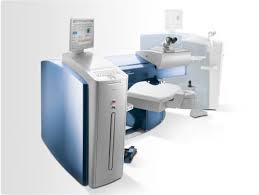
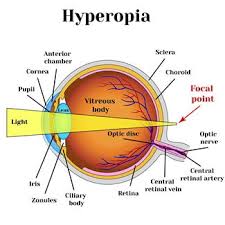
LASIK (Laser-Assisted In Situ Keratomileusis) is the most widely performed laser vision correction procedure in the world. It uses a femtosecond laser to create a thin corneal flap, lifts it to expose the underlying stroma, and uses an excimer laser to reshape the corneal surface — correcting myopia, hyperopia, and astigmatism by permanently changing how the cornea focuses light.
For SSC CPO candidates, the relevance is direct. If your current prescription places your uncorrected vision below the required standard — and LASIK would bring it above that standard — then LASIK is the procedure that potentially changes your medical eligibility status. It does not guarantee eligibility; it removes the specific optical barrier of refractive error from the eligibility equation.
Understanding exactly who is a suitable candidate for LASIK — including the prescription ranges treatable and the corneal requirements — is the essential next step before committing to the procedure. Our overview of LASIK eye surgery candidacy explains the clinical criteria in detail.
Advantages of LASIK for SSC CPO Candidates Specifically
Beyond the eligibility dimension, LASIK carries several practical advantages that are particularly relevant for candidates in paramilitary roles:
- Permanent glasses-free operation: Sub-Inspectors and ASIs often work in environments where glasses are physically impractical — fieldwork, physical confrontations, adverse weather, and night operations. LASIK eliminates this operational limitation permanently.
- Contact lens elimination: Dust, smoke, and high-exertion environments make contact lens wear uncomfortable and hygienically problematic for field personnel. LASIK removes this entirely.
- Fast recovery: Most LASIK patients return to normal daily activity within 24–48 hours. The recovery is not the prolonged disruption that many candidates anticipate.
- Long-lasting results: LASIK correction is permanent. For a career spanning 30+ years in a paramilitary service, the investment in a one-time procedure delivers decades of clear unaided vision.
A full breakdown of what LASIK offers beyond simply removing glasses — including contrast sensitivity, night vision improvements, and the practical advantages for active roles — is covered in our guide to the benefits of LASIK eye surgery.
When to Have LASIK Relative to the SSC CPO Medical?
Timing is one of the most practically important decisions for any SSC CPO candidate considering LASIK. Having surgery too close to your medical examination date creates two risks: first, your vision may not have fully stabilised; second, the medical examiner may be more likely to note recent surgical history and subject your eyes to additional scrutiny.
The general clinical guidance — and the standard most recruitment medical boards look for when LASIK is disclosed — is a post-operative period of at least six months before the medical examination. By six months, the cornea has completed its primary healing and epithelial remodelling, the prescription has stabilised, and visual acuity has reached its final post-operative level. This is the window from which your vision result is most reliable and most defensible at examination.
Our detailed resource on LASIK surgery recovery time covers the week-by-week progression of post-operative healing — including exactly when vision stabilises, when activity restrictions lift, and what the examination at each post-operative milestone involves. This timeline is directly relevant to planning your surgical date around the SSC CPO calendar.
What to Disclose at the Medical Examination?
This section is non-negotiable: disclose your LASIK history completely and honestly at the SSC CPO medical examination. Do not attempt to conceal that you have had the procedure.
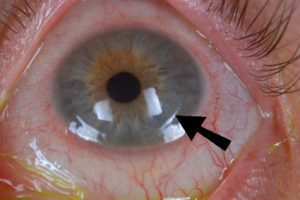
There are two reasons this matters. First, the corneal changes produced by LASIK are visible on slit-lamp examination — an experienced medical officer will identify them regardless of whether you mention them. Second, any concealment of medical history during a government recruitment medical is a disqualifying act independent of the vision outcome. Candidates have been disqualified not because their post-LASIK vision failed the standard, but because they misrepresented their medical history.
When disclosing, bring documentation: your pre-operative refraction, the date of surgery, the procedure performed, and your post-operative vision records. A letter from your treating ophthalmologist confirming stable post-operative vision is a valuable supporting document.
LASIK and Other Government / Defence Exams
SSC CPO is one of several government and defence service examinations where the LASIK eligibility question arises. The approach across these examinations varies — some forces have explicitly updated their medical standards to accept post-LASIK candidates meeting the vision criteria; others retain older restrictions that have not been formally revised.
For candidates appearing for SSC GD (Constable), the vision and LASIK eligibility question is closely related but has its own specific standards — our dedicated guide on whether LASIK is allowed in SSC GD covers that examination specifically. For candidates also considering NDA or defence service academies, the eligibility framework differs again — our resource on whether LASIK is allowed in NDA gives the defence-specific picture.
Conclusion
LASIK surgery is not prohibited for SSC CPO candidates. What matters is your post-operative vision — whether it meets the unaided standard prescribed for the specific paramilitary organisation you are applying to. If LASIK brings your vision to that standard, it resolves the eligibility barrier. If it does not — because your prescription was too high, or because full correction was not achieved — the procedure does not help your candidacy regardless of how well-performed it was.
The right approach is to get a comprehensive pre-operative assessment, confirm your surgical candidacy, plan your surgery at least six months before your expected medical date, and disclose your history fully when you appear. Book a consultation at Visual Aids Centre to find out whether your prescription and corneal profile make LASIK the right decision for your SSC CPO candidacy.
Frequently Asked Questions (FAQs)
Does LASIK disqualify a candidate from SSC CPO?
No. LASIK surgery does not disqualify candidates. Post-operative vision meeting the prescribed standards is what matters. Candidates who achieve the required unaided vision after LASIK are treated the same as candidates who naturally meet those standards.
What are the vision standards for SSC CPO?
Generally 6/6 in the better eye and 6/9 in the worse eye for distance, without optical correction. Near vision standards and colour vision requirements also apply. Always verify the exact standard from the official notification for your specific recruitment cycle and organisation.
How long before the SSC CPO medical should I have LASIK?
At least six months before the scheduled medical examination. This allows full corneal stabilisation, vision settlement, and provides post-operative documentation that confirms stable results at the time of examination.
Do I need to disclose LASIK at the SSC CPO medical?
Yes — always and completely. Corneal LASIK changes are visible on slit-lamp examination regardless of disclosure. Concealing your surgical history is a disqualifying act independent of your vision result. Bring full pre- and post-operative documentation.
What if my post-LASIK vision does not meet the standard?
If your post-operative vision does not meet the prescribed standard without optical correction, LASIK does not change your eligibility position. Speak with your surgeon about whether your prescription range and corneal profile are suitable for achieving the required level of correction before proceeding.
Is LASIK eligibility the same across all SSC CPO organisations?
Each organisation — CISF, CRPF, BSF, ITBP, SSB — has its own medical standards that may differ slightly. The approach to LASIK candidates also varies. Always refer to the specific recruitment notification for your target organisation rather than relying on a general rule.
👁️ MEDICALLY REVIEWED BY
Padmashree Dr. Vipin Buckshey
MS Ophthalmology | AIIMS Graduate, 1977 | Padma Shri Honouree | Government Exam Medical Eligibility Consultant, Visual Aids Centre
A significant proportion of LASIK consultations at Visual Aids Centre involve candidates preparing for government, paramilitary, and defence recruitment medicals. Over decades of this work, Dr. Vipin Buckshey has developed a precise understanding of how different recruitment bodies evaluate post-LASIK vision — what they look for at the slit lamp, what documentation they expect, and which candidates are most likely to successfully navigate the medical after the procedure. The guidance in this article reflects that clinical and practical experience rather than a general reading of recruitment rules. An AIIMS alumnus since 1977, Padma Shri honouree, and former President of the Indian Optometric Association, Dr. Buckshey’s review ensures that candidates relying on this article receive guidance grounded in real recruitment medical outcomes. Learn more about the Visual Aids Centre team at our story.