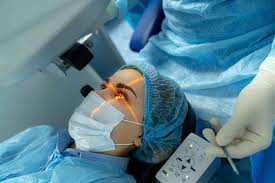

Most patients manage light reading within 24 hours, and normal reading returns within about a week after SMILE surgery.
That’s the general timeline — most pages stop right there. If you’re 40 or older, or your eyes feel tired even when your vision tests perfectly clear, keep reading: here’s the real data behind those numbers, the presbyopia question almost nobody raises before surgery, and why fatigue and blur aren’t actually the same problem.
Key Takeaways
- 74% of eyes reach 20/20 vision or better within 24 hours of SMILE, and nearly all reach functional vision the same day — recovery is often faster than patients expect.
- If you already needed reading glasses before surgery, standard SMILE won’t remove that need — it corrects distance vision, not presbyopia, a distinction most recovery-timeline pages skip entirely.
- SMILE monovision is a real, published alternative for presbyopic patients — one study found 92% of patients achieved independence from reading glasses this way.
- Screens don’t reduce your blink rate more than printed books do — but they roughly double the rate of incomplete blinks (7.02% vs. 4.33%), which is the more precise reason screens feel harder on healing eyes.
- Tired eyes when reading aren’t the same problem as blurry eyes — a published study found your eye’s near-focusing muscle temporarily weakens for about a month after SMILE, which explains fatigue that clarity alone doesn’t.
- Most reading difficulty in the first week is completely normal — real red flags look different, and they’re rare.
The Facts, Verified
What the published data actually shows — not a generic recovery calendar.
| Verified fact | Why it matters for you |
|---|---|
| In one study, 74% of eyes achieved 20/20 vision or better within 24 hours of SMILE, and 98.85% reached functional vision the same day | Most patients can realistically expect usable reading vision almost immediately, not after a long wait |
| In a published SMILE monovision study, 92% of patients achieved independence from reading glasses, with 82% reading fine newsprint unaided | If you’re presbyopic, this is a genuine option worth discussing before surgery, not a surprise after it |
| Reading from a screen produces roughly double the rate of incomplete blinks compared to print (7.02% vs. 4.33%), even though overall blink frequency is similar | It’s not “reading” that’s harder on healing eyes — it’s specifically screens, which matters for how you plan your first week |
| Vision continues to sharpen for days to weeks after SMILE as corneal healing progresses | Some blur or fluctuation while reading fine print early on is expected, not a sign of a problem |
| In a 42-patient study, near-focusing power (accommodation) dropped temporarily at 1 week post-SMILE, then recovered to at or above baseline by 1 month | Eye fatigue during reading is often a focusing-muscle issue, not blurry vision — and it’s temporary for almost everyone |
Sources: Scientific Reports (SMILE early recovery study); Eur J Ophthalmol (Luft et al., SMILE monovision); blink-pattern research (Chu et al.).
Why Does Reading Feel Different Right After SMILE?
Reading demands more from your eyes than almost anything else — sustained near focus, fast eye movement across lines, and a steady tear film, all at once. Right after SMILE, your cornea is still remodeling around the tiny incision used to remove the lenticule, a different (and gentler) healing process than SMILE Pro’s keyhole approach was designed for, though not one that’s eliminated entirely.
Most day-to-day improvement happens fast, but full stabilization takes longer than patients assume — see exactly how long vision takes to stabilize after SMILE for that full timeline. Reading lags slightly behind distance vision simply because it demands more precision from a still-healing surface.
Why Do Your Eyes Feel Tired, Not Just Blurry, When Reading?
Most recovery guides treat “reading discomfort” as one thing: blur that fades as the cornea heals. But a 42-patient study found something more specific — the eye’s near-focusing muscle (accommodation) temporarily weakens in the first week after SMILE, independent of how clear your vision measures on a chart. That’s why you can pass a vision test and still feel your eyes tire out fast over a page or a screen.
The same study found this dip resolves on its own for most patients by one month, and patients who started with lower near-focusing reserves were the ones most likely to notice it. If fatigue lingers past that window, targeted near-focusing exercises measurably helped in the study group — worth raising with your surgeon rather than assuming something went wrong. For a broader look at strain specifically (not just this accommodation angle), see our page on eye strain after SMILE surgery.
What Does Your Reading Experience Actually Mean?
| What you’re noticing | What it means | Action |
|---|---|---|
| Mild blur on fine print, first few days | ✅ Normal early healing | Take breaks, avoid pushing through discomfort |
| Comfortable reading most text by day 4–7 | ✅ On the expected recovery curve | Continue easing into longer sessions |
| Holding text at arm’s length or feeling like you need reading glasses, especially if you’re over 40 | ⚠️ Likely presbyopia, not a surgical issue | Ask whether reading glasses were ever part of your plan, or whether a monovision approach suits you |
| Eye strain specifically during phone or laptop reading, less so with print | ⚠️ Consistent with the screen-specific blink pattern above | Pace screen sessions more than print sessions during recovery |
Source: published near-vision and blink-pattern research cited above.
If screens are unavoidable for work, it’s worth knowing which procedures suit heavy screen use best — a useful comparison if you’re still weighing your options or advising someone who is.
| Consideration | Standard SMILE | SMILE Monovision |
|---|---|---|
| Corrects distance vision | Yes, both eyes | Yes, both eyes |
| Corrects near/reading vision directly | No | Yes, in the non-dominant eye |
| Reading-glasses independence (published study) | Not targeted | 92% of patients |
| Best suited for | Patients under ~40 without presbyopia | Presbyopic patients wanting fewer reading glasses |
Source: Eur J Ophthalmol (Luft et al., SMILE monovision study).
When Should Reading Discomfort Actually Concern You?
Almost never, for the ordinary blur-and-fluctuation pattern above — it resolves on its own as healing progresses. The genuine exception: distorted lines, ghosting, or astigmatism-like smearing of text that doesn’t ease over following weeks deserves a direct conversation with your surgeon — see residual astigmatism after SMILE for this exact pattern.
SMILE’s correction is also designed to be stable long-term, so reading vision that’s genuinely good at one month typically doesn’t drift back over time — a real regression months or years later is a different conversation than early fluctuation, and worth flagging separately.
Bottom Line
Reading recovers faster after SMILE than most timelines suggest — light reading within a day, comfortable reading within a week. The real planning question is presbyopia, not healing speed: if you’re 40+, raise reading glasses and monovision with your surgeon before surgery, not after. See the fuller benefits of SMILE surgery, or reach out to our team with questions specific to your prescription.
FAQs
Is it safer to read a physical book than my phone during recovery?
Not for blink rate specifically — both are similar. Screens do cause more incomplete blinks though, so pacing screen sessions with breaks matters more than switching to print. See phone use guidance after SMILE for the fuller picture.
Will SMILE get rid of my reading glasses?
Only if presbyopia correction was specifically planned into your procedure, such as with a monovision approach. Standard SMILE corrects distance vision, not the age-related near-focus loss that causes reading-glasses dependence.
Does SMILE being painful affect how soon I can read comfortably?
Most patients report SMILE as notably comfortable, which is part of why early reading is often more tolerable than expected. See what the procedure and recovery actually feel like if that’s a specific concern.
How long until I can go back to a reading- or screen-heavy job?
Most patients manage light screen work within a few days and full days by the following week, similar to returning to other normal activities after SMILE — pace yourself based on comfort rather than the calendar.
Why does my near vision feel worse than my distance vision right now?
Reading demands more precision from a still-healing corneal surface than distance viewing does, so a short lag between the two is normal in the first week or two.
Should I use reading glasses temporarily during recovery if text looks blurry?
Only if your surgeon recommends it for your specific case — for most patients, mild early blur resolves on its own without needing an interim prescription.
👁️ MEDICALLY REVIEWED BY
Padmashree Dr. Vipin Buckshey
Optometrist & Laser Vision Correction Specialist | AIIMS Graduate, 1977 | Padma Shri Honouree | Official Optometrist to the President of India | Former President, Indian Optometric Association | Founder, Visual Aids Centre
Patients often ask when they can get back to their books or their inbox, and the honest, data-backed timeline tends to reassure far more than a vague “give it time.” Dr. Vipin Buckshey founded Visual Aids Centre in 1980, and in 1999 it became the first eye centre in Delhi to introduce LASIK. The centre reports over 250,000 Laser Vision Correction procedures to date. This article reflects published clinical literature on SMILE recovery and is general information rather than medical advice — contact your surgeon directly if reading vision hasn’t improved along the expected timeline. Read more at our story.