
If you have just had SMILE Pro — or are preparing for it — the question is reasonable: when will my vision actually settle? The honest answer has three parts. You will see usably well within 24 hours, reach functional stability between 4 and 6 weeks, and continue small refinements for another three to six months. Anyone promising instant 20/20 is skipping a real biological process; anyone warning of months of blurry discomfort is overstating the recovery. SMILE Pro sits between those extremes, and the curve is predictable enough to plan around.
This guide from Visual Aids Centre walks through what happens inside your cornea at each phase, which fluctuations are normal, the habits that speed things up, and the signs that tell you to call your surgeon.
Key Takeaways
- Usable vision returns within 24 hours — most patients are at or above the legal driving standard by the next morning.
- Functional stabilisation takes 4 to 6 weeks as the cornea completes its initial remodelling.
- Minor fluctuations during the first month are normal — they reflect corneal hydration shifts, not a failed result.
- Full visual refinement continues quietly for 3 to 6 months, especially in night vision and contrast sensitivity.
Understanding SMILE Pro and the Cornea
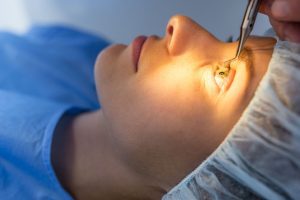
SMILE Pro is a flapless refractive procedure for myopia and astigmatism. It runs on the ZEISS VisuMax 800 femtosecond laser and delivers the actual correction in 7 to 9 seconds per eye. A precisely calculated disc of corneal tissue — the lenticule — is shaped inside your cornea and extracted through a 2–3 mm side incision. No flap, no stitches, and far more structural integrity preserved than in flap-based procedures.
This matters for stabilisation because how quickly your vision settles depends on how much remodelling the cornea has to do. Our article on whether SMILE Pro actually reshapes the cornea covers the optics in depth. The short version: yes, the curvature is permanently altered, and the epithelial and stromal layers then spend several weeks settling into that new geometry. That settling is what patients experience as fluctuating vision.
The Early Days: First Improvements and Fluctuations
In the first hours, most patients notice their vision is already much clearer than pre-op — but not yet crisp. Mild haziness, light sensitivity, and a slight watery quality are all normal. By the next morning, 95% or more of patients can read the 6/9 line without correction — above the legal driving threshold in India.
Here it gets interesting. Between day 2 and the end of week 2, many patients experience small fluctuations — vision might feel sharper in the morning and hazier by evening, or crisper on day 3 than on day 5. This is not regression. It reflects the ongoing corneal healing process after SMILE Pro, during which tear film quality, hydration, and epithelial smoothness all vary hour by hour.
A brief period of mild blurriness is also common and not cause for concern. Patients occasionally worry something has gone wrong — usually it hasn’t.
Reaching the Summit: Stabilising Vision
By the one-week mark, most patients reach a state where their vision is clearly more stable than fluctuating. Day-to-day swings become subtler and overall clarity feels reliably good. Our detailed walkthrough of what vision looks like one week after SMILE Pro covers what most patients report at that milestone.
Between weeks two and six, functional stability is achieved. Your prescription has settled into its new baseline, your surgeon can confidently measure the final refractive outcome, and any remaining refinement is subtle enough that most patients don’t consciously notice it. This is when people typically feel their surgery is “done”. Compared with older SMILE, SMILE Pro’s recovery is faster — see our article on why recovery is faster with SMILE Pro than with older SMILE.
From week six to three or six months, most of what’s happening is neural adaptation rather than optical change. Your brain learns to process the sharper signal, night vision quietly improves, and contrast sensitivity sharpens. This is part of why people often say their vision is better at three months than it was at three weeks.
Patience Is Key: A Recipe for Optimal Recovery
Following your post-operative instructions is the biggest predictor of how smoothly stabilisation goes. The small habits you build during the first month determine how quickly you reach final clarity. For the full list, see our guide on the dos and don’ts after SMILE Pro eye surgery. The essentials:
- Protect your eyes outdoors. UV-blocking wraparound sunglasses reduce light sensitivity and shield the healing surface from dust and wind.
- Never rub your eyes. The incision edge is still sealing, and gentle rubbing in the first week can disrupt that.
- Limit intense screen sessions. Blink rate drops sharply during screen use, drying the surface exactly when it needs hydration.
- Use your drops on schedule. Each prescribed drop does specific work — skipping them extends the stabilisation window.
- Attend every follow-up. Your surgeon needs to see your cornea at 24 hours, one week, and one month to catch any deviation early.
For the full week-by-week picture, what to expect during recovery after SMILE Pro walks through each phase.
Beyond the Numbers: Embracing Clear Vision
Checking your vision against a timeline is natural, but obsessing over daily changes can itself become a source of anxiety. Age, original prescription, tear film quality, healing biology, and post-op discipline all influence your curve. What matters more than hitting each milestone on time is the direction — and for the vast majority of SMILE Pro patients, the direction is unambiguously positive.
Conclusion
SMILE Pro stabilisation is a three-phase process: usable vision within 24 hours, functional stability between 4 and 6 weeks, and quiet refinement for another 3 to 6 months. Minor fluctuations in the first month are expected, not alarming. Patients who follow their drop schedule, protect their eyes outdoors, and attend every follow-up reach their final vision with the fewest surprises. For a personalised assessment of how your individual recovery is likely to unfold, book a consultation at Visual Aids Centre.
Frequently Asked Questions (FAQs)
How soon after SMILE Pro will I see clearly?
Most patients have usable clear vision within 24 hours, with the typical first-morning result at or above the driving standard. Full sharpness settles over the following weeks.
Is it normal for my vision to fluctuate after SMILE Pro?
Yes. Small daily fluctuations during the first 2–4 weeks are part of normal corneal remodelling and tear film stabilisation. They usually resolve by the 4–6 week mark.
When is my SMILE Pro vision considered fully stable?
Functional stability is reached between weeks 4 and 6, and surgeons consider the result “final” at around 3 months. Subtle refinements can continue quietly up to 6 months.
Can anything speed up vision stabilisation after SMILE Pro?
Following your drop schedule, protecting eyes from dust and UV, avoiding eye rubbing, and limiting long screen sessions all shorten the stabilisation window meaningfully.
Why does my vision seem sharper in the morning than in the evening?
Tear film quality varies through the day, and in the first weeks, a less stable tear film affects clarity more than usual. It typically evens out by week 3 or 4.
When should I call my surgeon about vision concerns?
If vision worsens rather than fluctuates, if you develop significant pain, new halos or flashes, or if clarity has not meaningfully improved by the end of week two, contact your surgeon promptly.
👁️ MEDICALLY REVIEWED BY
Padmashree Dr. Vipin Buckshey
Optometrist & Refractive Recovery Specialist | AIIMS Graduate, 1977 | Padma Shri Honouree
With more than four decades of clinical experience and over 250,000 laser vision correction procedures supervised at Visual Aids Centre, Dr. Vipin Buckshey has guided thousands of SMILE Pro patients through their stabilisation phase — distinguishing routine fluctuations from genuine concerns at every follow-up. An AIIMS alumnus, former President of the Indian Optometric Association, official optometrist to the President of India, and Padma Shri recipient, Dr. Buckshey founded Visual Aids Centre in 1980 and introduced Delhi’s first private LASIK laser in 1999. The clinic invested in the ZEISS VisuMax 800 SMILE Pro platform to bring India’s most advanced refractive technology to Delhi patients. Learn more about the clinic’s four-decade journey in our story.