
Every laser vision procedure works on the same basic principle: change the shape of the cornea so light focuses correctly on the retina. So when people ask whether SMILE Pro “reshapes” the cornea, the honest answer is yes — but how it does that is what makes it genuinely different from the procedures that came before it.
Understanding the mechanism isn’t just academic curiosity. It explains why SMILE Pro is flapless, why it tends to preserve more corneal strength, and why recovery feels the way it does. This guide from Visual Aids Centre walks through exactly how SMILE Pro reshapes the cornea, what happens to the tissue, and how that compares to LASIK and PRK.
Key Takeaways
- Yes — SMILE Pro reshapes the cornea, but by removing a precisely cut disc of tissue (a lenticule) from inside it, rather than ablating the surface.
- The reshaping happens within the corneal stroma, the thick middle layer, leaving the surface layers largely intact.
- No flap is created. The lenticule is removed through a tiny keyhole incision of just a few millimetres.
- By preserving the front of the cornea, SMILE Pro retains more structural strength than flap-based LASIK.
- The reshaping is permanent, and the change in focus corrects short-sightedness and astigmatism.
Yes — But Not the Way You Might Expect
SMILE Pro absolutely reshapes the cornea. That reshaping is what corrects your vision — by altering the cornea’s curvature, light is bent to land precisely on the retina instead of in front of it. What surprises people is the method. Older laser procedures reshape the cornea by removing tissue from its surface or from beneath a flap. SMILE Pro does it from within, by extracting a single, precisely shaped piece of tissue through a tiny opening.
That difference in approach is the whole story of why SMILE Pro behaves as it does. To see how it sits alongside other techniques, our comparison of how SMILE Pro differs from LASIK and PRK is a helpful overview before we get into the mechanics.
How SMILE Pro Reshapes the Cornea
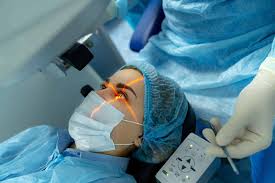
SMILE Pro is performed on the VisuMax 800 femtosecond laser, and the reshaping happens in two precise steps.
Step One: Creating the Lenticule
The laser fires ultra-fast pulses of light to a programmed depth inside the cornea, defining a small, lens-shaped disc of tissue called a lenticule. The exact dimensions of that disc are calculated from your prescription — its shape is, in effect, your refractive error translated into tissue. No cutting of the surface happens at this stage; the laser works entirely within the cornea.
Step Two: Removing the Lenticule
The surgeon then removes that lenticule through a small keyhole incision, just a few millimetres wide. Once the disc of tissue is gone, the cornea’s curvature settles into its new, corrected shape — flatter in the centre for short-sightedness, for example. That’s the reshaping, complete.The precise amount involved is covered in our guide on the procedure’s cylindrical correction range.
Which Part of the Cornea Is Reshaped?
The reshaping takes place in the corneal stroma — the thick, collagen-rich middle layer that makes up roughly 90% of the cornea’s thickness and gives it most of its structure. The lenticule is cut and removed from within this layer, while the outermost layers (the epithelium and Bowman’s layer) stay largely undisturbed.
This matters because the stroma is where refractive correction has always happened in laser surgery — it’s the tissue whose removal changes the cornea’s focusing power. The difference with SMILE Pro is that it reaches the stroma without lifting or removing the surface above it. For the deeper science of why this layer is central to vision correction.
How This Differs From LASIK and PRK
All three procedures reshape the stroma — they just reach it differently, and that’s where the experience diverges:
- PRK removes the surface epithelium entirely, then reshapes the stroma from the surface with an excimer laser. The epithelium regrows over several days.
- LASIK creates a hinged flap across the front of the cornea, lifts it, reshapes the stroma beneath, then lays the flap back down.
- SMILE Pro creates and removes a lenticule from inside the stroma through a small incision — no surface removal, no flap.
So the destination is the same, but SMILE Pro takes the least disruptive route to get there. A side-by-side look at the femtosecond approaches is set out in our comparison of SMILE Pro versus Femto LASIK, which shows how the flapless method changes the patient experience.
Why the Method Preserves Corneal Strength
Here’s the structural payoff of reshaping from within. The front layers of the cornea contribute significantly to its overall strength, rather like the outer skin of a structure. Because SMILE Pro doesn’t cut a large flap through those layers, more of that strength is preserved, which supports better long-term stability of the cornea.
This is also why SMILE Pro is often a strong option for people whose corneas need that strength conserved.
Is the Reshaping Permanent?
Yes. Once the lenticule is removed, that tissue is gone for good, and the cornea’s new shape is permanent. The surface heals over the small incision within days, and the cornea settles into its corrected curvature — a process described in does the cornea heal after SMILE Pro. The correction itself is designed to last.
It’s worth noting that “permanent reshaping” doesn’t freeze your eyes in time — natural age-related changes, such as the reading-vision shift of presbyopia in your forties, still happen because those involve the lens, not the cornea. But the myopia or astigmatism SMILE Pro corrects, and the corneal shape it creates, remain stable. For how effectively it handles stronger prescriptions, see can SMILE Pro fix high myopia.
Conclusion
So, does SMILE Pro reshape the cornea? Yes — precisely and permanently, but through a method that sets it apart. Rather than ablating the surface or lifting a flap, it removes a custom-shaped lenticule from within the corneal stroma through a tiny keyhole incision, leaving the front layers largely intact. The result is the same corrected curvature that other laser procedures achieve, but with more of the cornea’s natural strength preserved and a gentler route to get there. It’s reshaping by subtraction from the inside — elegant, accurate, and stable.
Curious whether SMILE Pro is the right reshaping method for your eyes and prescription? Book a consultation at Visual Aids Centre, and we’ll assess your cornea and explain your options clearly.
Frequently Asked Questions (FAQs)
Does SMILE Pro reshape the cornea?
Yes. It reshapes the cornea by removing a precisely cut, lens-shaped disc of tissue (a lenticule) from within the corneal stroma through a small keyhole incision, changing the cornea’s curvature to correct your vision.
Which layer of the cornea does SMILE Pro change?
The corneal stroma — the thick middle layer that makes up most of the cornea’s thickness. The surface layers above it stay largely undisturbed.
How is SMILE Pro reshaping different from LASIK?
LASIK lifts a flap to reshape the stroma beneath. SMILE Pro reaches the stroma by removing a lenticule through a small incision instead — no flap is created.
Is the corneal reshaping from SMILE Pro permanent?
Yes. The removed tissue doesn’t grow back, so the new corneal shape is permanent. The correction for myopia and astigmatism is designed to be long-lasting.
Does removing tissue weaken the cornea?
SMILE Pro is designed to preserve corneal strength by keeping the front layers intact. This generally retains more structural integrity than flap-based LASIK.
What does the lenticule’s shape represent?
Its dimensions are calculated from your prescription — it’s essentially your refractive error translated into a precise piece of tissue. Removing it leaves the cornea correctly shaped.
👁️ MEDICALLY REVIEWED BY
Padmashree Dr. Vipin Buckshey
Optometrist & Post-Operative Care Specialist | AIIMS Graduate, 1977 | Padma Shri Honouree | Refractive Surgery Specialist, Visual Aids Centre
Patients understand and trust a procedure far better when they grasp what it actually does to the eye, and Dr. Vipin Buckshey takes time at Visual Aids Centre to explain the mechanics of corneal reshaping in plain terms. Across four decades of refractive practice he has watched the field evolve from surface ablation to flap-based LASIK and now to the flapless, lenticule-based precision of SMILE Pro — and he is careful to explain why that progression matters for corneal strength and stability rather than simply calling the newest option “best.” The explanation in this article reflects the same accessible, accurate counselling his patients receive when deciding between procedures. An AIIMS alumnus, Padma Shri honouree, and former President of the Indian Optometric Association, Dr. Buckshey is known for making complex eye science genuinely understandable. Read more on our story.