If you’re wearing thick glasses or strong contact lenses, you’ve probably asked yourself: “Is my eye number too high for LASIK?” It’s one of the most common questions ophthalmologists hear — and for good reason. LASIK has helped millions of people ditch their glasses permanently, but it does have limits. And knowing exactly where those limits fall can save you from unrealistic expectations and help you find the right path to clearer vision.
Here’s everything you need to know about the myopia power limit for LASIK surgery, explained clearly and without the jargon overload.
Key Takeaways
- LASIK is generally considered safe and effective for myopia between –1.00 D and –8.00 D, with many surgeons treating up to –10.00 D depending on corneal thickness.
- Corneal thickness and residual stromal bed matter just as much as the power number.
- Very high myopia above –10.00 D usually needs alternatives such as SMILE Pro or EVO ICL.
- A full pre-surgical evaluation is the only reliable way to confirm LASIK eligibility.
What Is Myopia and Why Does Power Matter for LASIK?
Myopia, or nearsightedness, is a refractive error where the eye is slightly too long, causing distant objects to appear blurry. It’s measured in diopters (D) — the higher the negative number on your prescription, the stronger the myopia.
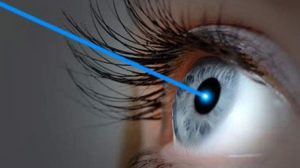
LASIK works by using a laser to reshape the cornea, changing how light bends to focus on the retina. The problem? Every laser ablation removes a thin layer of corneal tissue. The stronger your myopia, the more tissue needs to be removed — and there’s only so much cornea to work with safely.
This is why myopia power directly determines LASIK eligibility.
What Is the Standard Myopia Power Limit for LASIK?
In general, LASIK is considered safe and effective for myopia ranging from –1.00 D to –8.00 D, with most surgeons comfortable treating up to –10.00 D depending on corneal thickness. Beyond that, the risks increase significantly.
Here’s a quick breakdown:
- Mild myopia (–1.00 to –3.00 D): Excellent LASIK candidates. Is LASIK safe for mild myopia? — almost always yes.
- Moderate myopia (–3.00 to –6.00 D): Standard LASIK works well with appropriate screening.
- High myopia (–6.00 to –10.00 D): LASIK may still be possible, but corneal thickness and residual stromal bed are critical. Can minus 9 get LASIK? — possibly, with careful evaluation.
- Very high myopia (above –10.00 D): LASIK is generally not recommended. Prescription too high for LASIK? — alternatives are usually safer.
It’s worth noting that LASIK for –12D power is rarely advised, as removing that much tissue can destabilize the cornea and lead to post-surgical complications like ectasia.
It’s Not Just About the Number — Corneal Thickness Is Equally Critical
Many patients focus only on their diopter reading, but surgeons at Visual Aids Centre look at several factors before clearing anyone for LASIK.
Residual Stromal Bed (RSB)
After creating the flap and ablating tissue, a minimum of 250 microns of residual corneal stroma must remain to maintain structural integrity. Going below this threshold dramatically increases the risk of post-LASIK corneal ectasia — a condition where the cornea gradually bulges forward. If you’re wondering what happens if your cornea is too thin for LASIK, the short answer is: you won’t be cleared for the procedure.
Corneal Topography and Irregularities
Beyond thickness, the shape of your cornea matters. Irregular curvature, forme fruste keratoconus, or thin peripheral zones can disqualify someone even if their power is within range.
Pupil Size and Aberrations
Large pupils in low-light conditions can cause more visual side effects like halos or glare after LASIK, especially in high-myopia cases.
What Is the Maximum Eye Power LASIK Can Correct?
The maximum eye power LASIK can address in most cases tops out around –10.00 to –12.00 D when corneal anatomy is favorable. However, surgeons exercise extra caution in this range because high myopia LASIK carries a higher likelihood of regression — meaning your power may partially return over time.
The minimum prescription for LASIK is typically –0.75 D, as the corneal reshaping required for anything less is too minimal to be reliably accurate.
What About Astigmatism? Does It Affect the Power Limit?
LASIK can treat astigmatism alongside myopia, but it adds to the total amount of corneal tissue removed. The combined effect — called spherical equivalent — is what surgeons actually use when calculating safety thresholds. So if your myopia is –6.00 D with –2.00 D of astigmatism, the functional load on your cornea is closer to –7.00 D.
Better Alternatives When Myopia Is Too High for LASIK
If your power exceeds LASIK’s safe zone, you’re not out of options. Several advanced procedures are specifically designed for high myopia:
- SMILE Pro: A flapless, keyhole laser procedure that preserves more corneal integrity and is often preferred for powers up to –10.00 D with lower dry eye risk.
- Femto LASIK: A bladeless variant of LASIK that may be suitable for borderline cases with better precision.
- Contoura Vision: Topography-guided LASIK that corrects corneal irregularities for sharper outcomes.
- EVO ICL (Implantable Collamer Lens): For very high myopia (above –10.00 D), ICL is often the gold standard — a soft lens implanted inside the eye that leaves the cornea completely untouched.
The right choice depends on your exact prescription, corneal anatomy, and lifestyle needs. A thorough pre-surgical evaluation at Visual Aids Centre will determine which procedure is truly best for you.
Can LASIK Stop Myopia from Getting Worse?
This is a common misconception. LASIK corrects the current refractive error but does not stop myopia progression if the underlying causes — like excessive screen time or genetic factors — remain. That’s why surgeons typically require your prescription to be stable for at least 1–2 years before proceeding with surgery.
Getting Your LASIK Evaluation at Visual Aids Centre
At Visual Aids Centre, every LASIK candidate undergoes a comprehensive pre-surgical screening that includes:
- Corneal topography and pachymetry (thickness mapping)
- Dry eye assessment
- Pupil size measurement
- Refraction stability check
- Retinal evaluation
This thorough approach ensures your safety and sets realistic expectations for your outcome. You can also explore the LASIK surgery cost in Delhi to plan ahead financially.
Conclusion
The myopia power limit for LASIK surgery typically falls between –1.00 D and –10.00 D, but the real determinant is always a combination of your prescription, corneal thickness, and overall eye health. Numbers alone don’t tell the full story — which is exactly why a personalized consultation is essential.
If you’ve been told your power is too high, don’t be discouraged. SMILE Pro, ICL, and other advanced options exist precisely for cases like yours. The goal is always the same: clear, safe, long-lasting vision correction matched to your unique eyes.
Ready to find out if you’re eligible? Book a comprehensive eye evaluation at Visual Aids Centre today and take the first step toward a glasses-free life.
Frequently Asked Questions (FAQs)
What is the maximum myopia that LASIK can correct?
Most surgeons treat up to –8.00 to –10.00 D, depending on corneal thickness. Beyond –10.00 D, alternatives like ICL are usually safer.
Can someone with –7 or –8 diopters get LASIK?
Yes, in many cases. Candidacy depends on corneal thickness and overall eye health, not just the power number alone.
What happens if my myopia is too high for LASIK?
Your surgeon may recommend SMILE Pro, ICL, or another procedure suited for high myopia without the corneal risks.
Is LASIK permanent for high myopia?
LASIK corrects your current prescription permanently, but regression is more common in high myopia cases. Annual eye check-ups are advised.
Does corneal thickness matter more than myopia power?
Both matter equally. A patient with –9.00 D but thick corneas may qualify, while someone with –6.00 D and thin corneas may not.
What is the minimum power required for LASIK?
Typically –0.75 D or higher. Below this threshold, the laser cannot reliably or consistently reshape the cornea.
Can high myopia come back after LASIK?
Some degree of regression is possible, especially for powers over –6.00 D. Enhancement surgery or glasses may be needed years later.