
The first 24 hours after SMILE Pro eye surgery are simultaneously the most uncertain and the most remarkable of the entire recovery journey. You leave the clinic with eyes that feel strange and vision that is blurry — and wake up the next morning able to read the time on a clock across the room. That transition happens faster than almost every patient expects, and understanding what is driving it hour by hour makes it considerably less unsettling.
This guide from Visual Aids Centre walks you through exactly what is happening inside your eye — and what you should and should not be doing — across each phase of that first day. Knowing what is normal removes the anxiety, and knowing what is not normal means you call your surgeon at the right moment rather than too late.
Key Takeaways
- Blurry, foggy vision immediately after surgery is completely normal — it is the cornea’s initial response to the procedure, not a sign anything went wrong.
- Grittiness, light sensitivity, and watering eyes in the first two to six hours are expected and typically subside by the evening of surgery day.
- Most patients experience a “clarity shift” — a noticeable sharpening of vision — between six and twelve hours post-surgery.
- By hour 24, the majority of SMILE Pro patients have functional, glasses-free vision sufficient for daily tasks including driving short distances.
- The single most important rule across the entire first 24 hours: do not rub your eyes under any circumstances.
Immediately After Surgery: The First Hour
What Your Vision Looks Like Leaving the Clinic
SMILE Pro is performed under topical anaesthetic drops — no injections, no sedation. The laser component takes under ten seconds per eye. When you sit up in the treatment chair, the anaesthetic is still active and your eyes are working, but your vision at this precise moment will be blurry — sometimes significantly so, resembling the world viewed through a fogged or misted pane of glass. This is not a complication. It is the cornea’s immediate physiological response to the procedure: minor surface swelling and the residual effect of the anaesthetic drops create this initial softening of visual clarity.
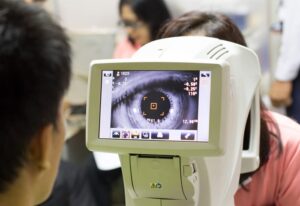
Your surgeon will examine your eyes immediately post-procedure using a slit lamp. If everything is as expected — and in the vast majority of cases it is — you will be fitted with protective eye shields and discharged with your drops and aftercare instructions. A trusted companion should drive you home; driving yourself is not safe or appropriate during this initial window regardless of how your vision feels.
Sensations to Expect
The dominant sensation for most patients in this first hour is eye sensitivity rather than pain. Eyes feel slightly heavy, unusually aware of themselves, and sensitive to bright light. Some patients describe it as the sensation of wearing a contact lens that has been in too long. Some notice their eyes watering more than usual as the anaesthetic fades. All of these responses are within the expected clinical range. The anaesthetic drops wear off fully within 30 to 60 minutes of the procedure, and mild discomfort may increase slightly during this window before beginning to settle.
Hours 2–6: Discomfort, Tearing and Light Sensitivity
What Is Happening Clinically
This is typically the most uncomfortable window of the entire SMILE Pro recovery journey — which, for most patients, means mild rather than severe. The corneal surface is actively responding to the procedure during this phase. The small incision is sealed but the epithelial cells around it are in active repair. The tear film — disrupted by the suction device and topical drops used during surgery — is still re-establishing its stable three-layer structure. The result is a combination of grittiness, light sensitivity (photophobia), and excessive watering that feels worse than it is clinically significant.
Light sensitivity during this phase is real enough that most patients find indoor lighting uncomfortable, let alone sunlight. Keeping the room dimly lit and eyes closed as much as possible during hours two through six is both comfortable and clinically useful — it reduces external stimulation of a corneal surface that is processing significant recent events. Wearing UV-blocking sunglasses even indoors helps significantly if ambient light is unavoidable.
Your Drops Schedule Starts Here
The eye drops prescribed by your surgeon are not a comfort measure — they are active clinical interventions. Antibiotic drops protect the healing incision from bacterial contamination during the most vulnerable window. Anti-inflammatory drops suppress the corneal inflammatory response that, if unchecked, can create swelling that delays visual clarity. Lubricating drops stabilise the tear film that your vision quality directly depends on. The timing of the first doses matters. Apply them exactly as directed — not when you remember, not when your eyes feel uncomfortable. Set phone alarms if needed. The first 24 hours are when drop compliance has the greatest clinical impact.
Hours 6–12: The Clarity Shift Arrives
The “Wow Moment” Most Patients Describe
Between six and twelve hours after SMILE Pro surgery, most patients notice a threshold moment — a point at which vision moves from blurry and uncertain to noticeably, sometimes dramatically clearer. Patients describe it in similar terms: “like someone turned the resolution up,” “I could suddenly read the TV from the sofa,” “I looked at my hand and could see every line.” This moment varies slightly in timing between patients, and some experience it as a more gradual progression rather than a sudden shift, but the underlying clinical event is the same: the initial corneal swelling has settled enough for the corrected refractive power of the eye to start expressing itself clearly.
Halos and starbursts around light sources — particularly lamps and screens — are still common at this stage and are normal. The cornea is still early in its stabilisation, and these optical effects reflect the transition state of healing tissue rather than any permanent change.
Screen Use: Brief and Mindful
Checking your phone at this stage is understandable and not harmful in moderation. Sustained screen use, however — hour-long streaming sessions, long work documents — is counterproductive. Screen use suppresses blink rate, which destabilises the already-recovering tear film and worsens both visual clarity and comfort. Brief checks are fine. Extended sessions belong to tomorrow or beyond. Rest and closed eyes remain the most productive use of this phase for your visual recovery.
Hours 12–24: Functional Vision and the Next Morning
What Most Patients Experience by Morning
Sleeping after SMILE Pro serves a genuine clinical function — not just rest, but active corneal healing. The epithelium does a significant portion of its repair work during sleep, and most patients wake up the morning after surgery with noticeably better vision than they had when they went to bed. The “reaching for glasses that aren’t there” moment is one of the most consistently described experiences in patient accounts at this point. It is disorienting in the best possible way.
By the 24-hour mark, the majority of SMILE Pro patients have vision that is functional for driving, reading, and screen work. Full prescription stability takes another two to three weeks, so minor fluctuations — particularly in low light or at day’s end — are still within the normal range. What should not be present at 24 hours: significant pain, worsening vision compared to the previous evening, or any discharge from the eye. Most patients at this point are less focused on managing symptoms and more focused on enjoying the results. Details about how long after SMILE Pro surgery you can drive are confirmed at your follow-up appointment based on measured visual acuity, not a general rule.
Sleeping With Eye Shields
Your protective eye shields are not optional accessories for the first night — they are preventing you from rubbing your eyes unconsciously while you sleep, which is a genuine risk that patients consistently underestimate. Most surgeons advise wearing shields for the first three to seven nights. Do not skip this step because you feel confident you will not rub your eyes in your sleep. You will not know if you do.
The Non-Negotiable Care Rules for Day One
- Do not rub your eyes. Not gently, not once, not to relieve itchiness. The keyhole incision is sealed but not yet integrated. Any pressure on the eye surface in the first 24 hours carries risk that is entirely avoidable.
- Take all prescribed drops on schedule. Antibiotic, anti-inflammatory, and lubricating drops are all clinically necessary during this window. Missing a dose is not trivial on day one.
- Rest with eyes closed as much as possible in the first six hours. This is when healing is most active and external stimulation is least helpful.
- Wear sunglasses outdoors — and indoors if light is uncomfortable. UV protection and reduced glare are both clinically appropriate on day one.
- Avoid water near the eyes when showering. Face away from the shower head, keep eyes closed, and do not use soap or shampoo near the eye area on day one.
- Eat, hydrate, and sleep normally. Proper hydration and good sleep quality directly support epithelial repair. This is not soft advice — it has a biological mechanism behind it.
For a complete list of activity-specific guidance beyond the first day, our detailed guide on what to avoid after SMILE Pro eye surgery maps out the key restrictions week by week.
Symptoms That Need an Immediate Call to Your Surgeon
The following experiences are outside the expected clinical range for the first 24 hours and warrant same-day contact with your surgical team — not a wait-and-see approach, and not a search engine query.
- Severe or sharp pain that is worsening rather than improving after the first two hours. Mild grittiness is expected; intense, escalating pain is not.
- Sudden significant vision loss — a dramatic drop in clarity that is not resolving with lubricating drops within 30 minutes.
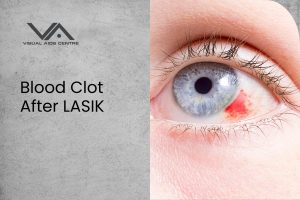
- Extreme redness concentrated in one area of the eye, particularly if combined with discharge.
- Discharge that is not clear — yellow or green discharge at any point in the first 24 hours is an infection signal that needs same-day clinical assessment.
- Feeling of something physically wrong inside the eye — distinct from grittiness, a sensation that something has shifted or is misaligned.
These symptoms are uncommon, but they are the clinical signals that benefit most from early detection. Visual Aids Centre’s post-operative care team is available for exactly these calls — please make them.
Your First Follow-Up Appointment
Most patients have a scheduled follow-up review within 24 to 48 hours of SMILE Pro surgery. This is not a routine administrative check — it is a clinical assessment of whether your healing trajectory is on track. Your surgeon will measure your visual acuity, examine the corneal surface and incision site, and confirm that your drop schedule is appropriate for how your eyes are healing. Any early refractive surprise — an under-correction or over-correction — is far easier to address when identified at this first review than at the one-month appointment.
Prepare specific, factual observations to share: which eye felt more comfortable, whether vision in one eye seemed significantly different from the other, any unusual visual effects you noticed during the night. These details help your surgeon calibrate the follow-up assessment.
Conclusion
The first 24 hours after SMILE Pro surgery follow a remarkably consistent arc: initial blur, a few uncomfortable hours as the cornea begins its response, a clarity shift between hours six and twelve, and functional glasses-free vision by the following morning. Understanding this arc hour by hour means you are not alarmed by what is normal — and you recognise promptly what is not.
Three things matter most on day one: take your drops on schedule, keep your hands away from your eyes completely, and rest as much as possible in the early hours. Do those three things well and you are giving your surgery the best possible start. If you have specific questions about what to expect based on your prescription or eye health history, Visual Aids Centre’s team can give you a personalised overview. Book a pre-operative assessment and understand exactly what your own recovery is likely to look like before the procedure, not after.
Frequently Asked Questions (FAQs)
Is blurry vision immediately after SMILE Pro surgery normal?
Yes, completely. Blurry vision in the first few hours after SMILE Pro is caused by minor corneal swelling and the residual effect of anaesthetic drops — both expected physiological responses to the procedure. For most patients, clarity improves significantly within six to twelve hours and functional vision is present by the following morning.
Can I go home alone after SMILE Pro surgery?
No. You should not drive yourself or travel alone on the day of surgery. Vision is blurry immediately post-procedure, and your eyes are sensitive. Arrange for a trusted person to accompany you and drive you home. This is a clinical recommendation, not a preference.
Is it normal to have watery eyes in the first few hours after SMILE Pro?
Yes. Excessive tearing in the first two to six hours is one of the most commonly reported post-operative experiences and is part of the cornea’s normal healing response. It does not indicate a complication and typically resolves by the evening of surgery day.
Can I watch TV or use my phone after SMILE Pro surgery?
Brief phone use is generally fine from hours six to twelve onwards if vision allows. Sustained screen sessions are not recommended on day one — extended screen use suppresses blink rate, destabilises the tear film, and slows the visual clarity progression. Structured rest serves your recovery better on the first day.
What happens if I accidentally rub my eyes in the first 24 hours?
Apply lubricating drops immediately, do not rub again, and monitor your vision over the next hour. If clarity changes noticeably or you feel something unusual inside the eye, call your surgical team the same day. A single gentle rub is unlikely to cause significant harm, but repeated rubbing or firm pressure carries real risk during the first 24 hours.
When will I know if my SMILE Pro surgery was successful?
Most patients have a strong indication of success by the morning after surgery, when functional clear vision is present. Formal confirmation of your corrected visual acuity is made at your first follow-up appointment within 24 to 48 hours, where your surgeon measures whether the correction landed on target. Full stability is confirmed at the one-month and three-month reviews.
👁️ MEDICALLY REVIEWED BY
Padmashree Dr. Vipin Buckshey
BS Ophthalmology | AIIMS Graduate, 1977 | Padma Shri Honouree | Senior Refractive Surgeon, Visual Aids Centre
The hour-by-hour guidance in this article is grounded in direct surgical observation. As the senior refractive surgeon at Visual Aids Centre who personally conducts the immediate post-operative examination following SMILE Pro procedures, Dr. Vipin Buckshey has assessed thousands of patients in the minutes and hours after surgery — making him uniquely placed to distinguish what is normal at each stage of the first 24 hours from what is not. An AIIMS alumnus, Padma Shri honouree, former President of the Indian Optometric Association, and official optometrist to the President of India, Dr. Buckshey’s clinical oversight ensures that what this article describes reflects surgical reality, not textbook generalities. Read more about Dr. Buckshey and the Visual Aids Centre surgical team.