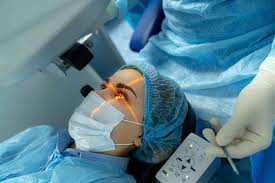

The only difference is the reshaping plan: Q-LASIK uses the same flap and laser as LASIK but protects your cornea’s natural curve.
Think Q-LASIK is a newer machine? It isn’t. “Q” is one setting in the laser’s software, and clinics use the letter in different ways, so the label alone tells you very little. Here’s what it really changes, and what to ask before you pay for it.
Key Takeaways
- Same surgery, different plan — only the laser’s reshaping profile differs.
- Q means asphericity — how your cornea’s curve changes from centre to edge.
- Standard LASIK flattens the centre — which can dull night vision quality.
- Evidence beats standard LASIK — but shows no clear winner over other custom types.
- Wide pupils aren’t a reliable reason — bigger prescriptions matter more.
- Ask what “Q” means — and what target Q your surgeon sets.
What Is the “Q” in Q-LASIK Measuring?
Q is the Q-value, a number for your cornea’s asphericity. A healthy cornea is steeper in the middle and flatter toward the edge, like the top of an egg. That shape scores a negative Q, and around -0.27 is linked with the least spherical aberration.
| Your Q-value | Corneal shape | What it means |
|---|---|---|
| Negative (about -0.27) | Steeper centre, flatter edge | Least spherical aberration |
| Zero | A perfect sphere | The neutral mark |
| Positive | Flatter centre, ball-like | More aberrations; weaker night vision |
Sources: Eye and Vision; BMC Ophthalmology.
Q-LASIK, often called Custom-Q in research, is a laser setting that tries to change your starting Q as little as possible while correcting your prescription. Many call it aspheric LASIK. The target is the surgeon’s choice: keep your own Q, or aim slightly more prolate to deepen focus, mainly in monovision plans. The flap is a separate choice, made with a blade or femtosecond laser.
How Does Standard LASIK Change Your Cornea’s Shape?
To fix short-sightedness, the laser flattens the centre, pushing Q upward and adding aberrations. Studies link that to weaker contrast and night vision even when the eye chart looks perfect. Q-LASIK limits the shift but cannot erase it: in one fellow-eye study, average Q moved from -0.2 to +0.6 with Custom-Q and +0.4 with wavefront-optimised treatment. See why night vision can dip after LASIK.
How Do LASIK Plans, Q-LASIK and SMILE Pro Compare?
| Type | Names on quotes | Plans from | Watch out for |
|---|---|---|---|
| Standard | Conventional | Your prescription | Flattens the centre |
| Wavefront-optimised | Allegretto Eye-Q | Prescription and corneal curve | Treats the average eye |
| Q-LASIK | Custom-Q, Q-adjusted, aspheric | Prescription and your average Q | Q varies with how it’s measured |
| Wavefront-guided | CustomVue, Zyoptix, CustomEyes | A validated wavefront scan | A poor scan can add aberrations |
| Topography-guided | Contoura, T-CAT | A detailed corneal map | Needs a clean, regular map |
| Ray-tracing | WaveLight Plus InnovEyes | A 3D model of the whole eye | Most data-heavy plan |
| SMILE Pro (a different method) | ZEISS VISUMAX 800 | Your prescription and a lenticule design | Its own eligibility and tissue rules |
Sources: CRSToday; Clin Ophthalmol; J Ophthalmol; Ophthalmology Times; ZEISS.
Q-LASIK needs less data than wavefront-guided treatment, so surgeons use it when a wavefront scan can’t be validated. Even experts disagree on the top rung: some back wavefront-guided, others topography-guided. For a tour, see types of LASIK, early wavefront platforms such as Zyoptix, and standard versus custom LASIK. The newer rungs are explained in topography-guided LASIK and the ray-tracing plan.
SMILE Pro sits outside the LASIK family. A femtosecond laser creates a lenticule in under 10 seconds, and it is removed through a small opening, so there is no flap and no excimer reshaping. It is approved in the US for short-sightedness with or without astigmatism; ZEISS says treating far-sightedness depends on local approval. See SMILE Pro and LASIK compared.
Does Q-LASIK Actually Beat Other LASIK Types?
| Compared with | What studies found | Plain meaning |
|---|---|---|
| Standard LASIK | 17 studies, 3,358 eyes: better Q and fewer aberrations | Likely better night-vision quality |
| Wavefront-optimised | 80 eyes: no significant difference in Q shift or aberrations | No clear winner |
| Topography-guided | 60 eyes, 1 year: 83% vs 87% reached 20/16 | No clear difference |
| Topography-guided vs wavefront-optimised | 11 studies, 1,425 eyes: fewer aberrations with topography | Customising to the corneal map helps |
Sources: Medicine meta-analysis; Eye and Vision; BMC Ophthalmology.
So Q-LASIK beats old-style LASIK on optics, but not clearly its modern rivals. Its edge over wavefront-optimised treatment was reported up to about -5 D of short-sightedness. These studies cover short-sightedness; far-sightedness has its own rules.
Does Q-LASIK Change How Much Cornea Is Left?
Every LASIK plan spends tissue on the flap and the laser. What remains is the residual bed. Surgeons once accepted 250 µm; most now prefer 300 µm.
| Step | Example (µm) | What to ask |
|---|---|---|
| Corneal thickness | 540 | Measured by corneal imaging |
| Flap | -110 | Femtosecond flaps are mostly 100 to 120 |
| Laser ablation | -80 | Varies with prescription and profile |
| Left behind | 350 | Most surgeons want 300 or more |
Sources: EyeWiki; Eye and Vision.
These figures are an illustration, not yours. One Custom-Q study found deeper central ablation than wavefront-optimised, though those eyes were also more short-sighted. If your cornea is thin, see the minimum corneal thickness for LASIK.
Do Wide Pupils Mean You Need Q-LASIK?
Many people believe so, and older lasers did make pupil size matter. Newer evidence is calmer.
| Stage | What studies found |
|---|---|
| First month | Glare, haze and halo scores were higher for every pupil size |
| Following months | Scores improved |
| Beyond 3 months | 19 studies found no lasting pupil-size link with a 6.0 mm or larger treatment zone |
| What did predict trouble | Larger prescriptions and leftover refractive error |
Sources: J Refract Surg; Ophthalmology; MedlinePlus.
So ask about a custom profile if your prescription is high, but pupil size alone is no reason. A repeat procedure may sharpen distance vision but not remove glare, so symptoms that last need a check; see persistent glare after LASIK.
Which Method Fits Which Eye?
| Your situation | Often considered | Why |
|---|---|---|
| Mild prescription, regular cornea | Standard, wavefront-optimised or Q | Simple and proven |
| Higher prescription | A custom profile with a large treatment zone | Q’s edge was reported up to about -5 D |
| Wavefront scan unreliable | Q or wavefront-optimised | Neither needs a wavefront scan |
| Irregular cornea or earlier surgery | Topography-guided | Treats irregularities on the map |
| Complex eye, want the most detailed plan | Ray-tracing | Models the whole optical system |
| Want no flap and no excimer laser | SMILE Pro | Lenticule removed through a small opening, if eligible |
| Thin cornea | Ask about tissue first | Ablation depth varies by profile |
Higher prescriptions raise extra questions; see LASIK for high myopia. The corneal map comes from a topographer such as the Topolyzer Vario. Your scans, not this table, decide.
What Should You Bring and Ask at Your Assessment?
| Do this | Why it matters |
|---|---|
| Stop contact lenses as advised | Lenses can temporarily reshape the cornea and skew its map |
| Bring past glasses prescriptions | Shows whether your power is stable |
| Describe your night driving | Helps decide if a custom profile is worth it |
| Ask which lasers, profile and target Q | Q, wavefront-optimised or topography-guided |
| Ask whether LASIK or SMILE Pro suits you | They are different methods with their own rules |
| Ask the treatment zone size | Larger zones are linked with fewer night problems |
| Ask for your tissue numbers | Flap, ablation and what is left |
| Ask for a written quote | Prices vary with laser, flap method and scans |
At Visual Aids Centre, planning uses the Alcon EX-500 excimer laser with Pentacam HR corneal imaging, Topolyzer Vario topography and WaveScan wavefront measurement. For more questions, read choosing a LASIK surgeon; for quotes, see LASIK cost in Delhi.
Bottom Line
Q-LASIK is LASIK with a reshaping plan that protects your cornea’s natural curve. It beats old-style LASIK on optics, but studies show no clear winner among modern custom types. Your scans should pick the plan, not the label. Contact our team for a personal assessment.
FAQs
Is Q-LASIK a different surgery from LASIK?
No. The flap and laser are the same; only the reshaping plan differs.
Is Q-LASIK better than standard LASIK?
On optics, studies say yes. On eye-chart results, they look similar.
Is Q-LASIK the same as wavefront LASIK?
No. Q uses your cornea’s shape; wavefront-guided uses measured aberrations.
Is Q-LASIK the same as Contoura?
No. Contoura is topography-guided. One trial found no clear difference at one year.
Does Q-LASIK remove less tissue?
Not always. One study found deeper central ablation than wavefront-optimised.
Is SMILE Pro a type of LASIK?
No. It removes a lenticule through a small opening, with no flap and no excimer laser.
Are wide pupils a reason to choose Q-LASIK?
Not on their own. Studies show no lasting pupil-size link with modern treatment zones.
Does Q-LASIK cost more?
It can. Prices depend on the laser, flap method and scans, so ask for a written quote.
👁️ MEDICALLY REVIEWED BY
Padmashree Dr. Vipin Buckshey
Optometrist & Laser Vision Correction Specialist | AIIMS Graduate, 1977 | Padma Shri Honouree | Official Optometrist to the President of India | Former President, Indian Optometric Association | Founder, Visual Aids Centre
Technology names can blur the real choice, so this guide separates what each LASIK plan actually changes from what it only claims. Dr. Vipin Buckshey founded Visual Aids Centre in 1980, and in 1999 it became the first eye centre in Delhi to introduce LASIK. The centre reports over 250,000 Laser Vision Correction procedures to date. This article is general information rather than medical advice, and your own surgeon’s guidance always takes priority. Read more at our story.