If your prescription reads -4.00 dioptres, you’re dealing with moderate myopia — distant objects are blurry without glasses, but your power is well within the range that modern laser vision correction can eliminate completely. The real question isn’t whether -4 can be reduced, but which method actually works and which ones waste your time.
Search online for “how to reduce -4 eye power” and you’ll find eye exercises, herbal drops, special diets, and screen-time hacks all claiming to lower your prescription. Some of these have modest benefits for eye health — but none of them will change a -4 reading on your refraction report. This article separates fact from wishful thinking and explains the options that genuinely work, from management (glasses, contacts) to permanent correction (Femto LASIK, SMILE Pro, and more).
Key Takeaways
- -4.00 dioptres is moderate myopia — caused by an elongated eyeball, not weak eye muscles.
- No exercise, diet, drop, or home remedy can structurally shorten the eyeball or flatten the cornea to reduce -4 power.
- Glasses and contact lenses manage the power; laser surgery eliminates it permanently.
- At -4, you’re an excellent candidate for virtually every laser procedure available today.
What Does -4 Eye Power Actually Mean?
A prescription of -4.00 D (dioptres) means your eye is myopic — it focuses light in front of the retina instead of directly on it. In practical terms, anything beyond about 25 centimetres from your face starts to blur without correction. You can read a book up close, but road signs, faces across a room, and cinema screens are indistinct.
The underlying cause is structural: either your eyeball is slightly longer than average (axial myopia) or your cornea is steeper than it should be, bending light too aggressively. This is an anatomical reality — not a “weakness” that can be strengthened. Understanding this distinction is critical, because it explains why exercises and supplements cannot reverse the condition. For a broader explanation of refractive errors and how they’re classified, see our refractive errors overview.
Can -4 Eye Power Be Reduced Naturally?
Eye Exercises — What They Can and Cannot Do
Eye exercises (palming, the 20-20-20 rule, pencil push-ups, focus shifting) are frequently promoted as a way to “cure” myopia. Here’s what the evidence actually says: these exercises can relieve eye strain, reduce fatigue from prolonged screen use, and improve focusing flexibility (accommodative function). What they cannot do is change the physical length of the eyeball or reshape the cornea. A -4 prescription exists because your eye is structurally too long — no exercise can shorten it. Our detailed analysis on eye exercises for vision improvement covers this in full.
Diet and Lifestyle — Supportive, Not Corrective
Good nutrition supports overall eye health. Vitamin A, omega-3 fatty acids, lutein, and zeaxanthin protect the retina and tear film. Spending time outdoors has been shown to slow myopia progression in children (not reverse existing myopia in adults). Reducing excessive screen time can prevent further strain. All of these are genuinely good habits — but they won’t move your -4 prescription towards zero. If you’re interested in nutrition and eye health, our guide on foods to improve eyesight provides an honest assessment of what diet can and cannot accomplish.
Ayurvedic Drops and Home Remedies — No Clinical Evidence
Rose water drops, triphala eye washes, honey-based solutions, and various herbal formulations are widely marketed in India as myopia cures. There is no peer-reviewed clinical evidence that any of these can reduce a -4 prescription. More importantly, unregulated eye drops carry real risks — contamination, allergic reactions, and corneal damage. If you’re exploring natural approaches, do so for general wellness — but don’t expect them to replace your glasses. For an evidence-based look at reducing eye number naturally, our article provides a thorough reality check.
How Glasses and Contact Lenses Manage -4 Power
Glasses and contact lenses are the most common way people manage -4 myopia. They work by placing a concave (diverging) lens in front of the eye, which shifts the focal point backward onto the retina. Vision is clear as long as you’re wearing them — remove them, and you’re back to blurry distance vision.
At -4, glasses lenses are noticeably thick (especially in larger frames), which is one of the reasons many patients at this power begin considering permanent solutions. Contact lenses solve the thickness problem but introduce their own issues: dry eyes, infection risk with poor hygiene, discomfort in dusty or air-conditioned environments, and the ongoing cost of replacements. For patients who’ve considered whether LASIK compares favourably to lifelong glasses, -4 is often the tipping point where surgery becomes financially and practically worthwhile.
Laser Eye Surgery — The Permanent Solution for -4 Myopia
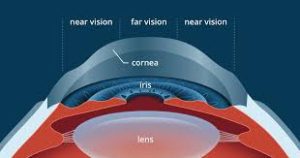
Laser vision correction is the only proven method to permanently eliminate -4 eye power. These procedures reshape the cornea so that light focuses directly on the retina without any external lens. At -4 dioptres, you’re in the comfortable middle of the treatable range for every major laser platform — meaning outcomes are highly predictable and the amount of corneal tissue removed is moderate.
Contoura Vision
Contoura Vision is a topography-guided LASIK procedure that maps 22,000 points on the corneal surface to create a personalised ablation profile. For a -4 prescription, this means the laser doesn’t just correct the spherical power — it also addresses micro-irregularities that standard LASIK doesn’t see. Many patients achieve better than 6/6 (20/20) vision. The procedure involves creating a femtosecond flap, so recovery is rapid — most patients see clearly within 24 hours.
Femto LASIK
Femto LASIK uses a femtosecond laser (not a blade) to create the corneal flap, followed by an excimer laser to reshape the underlying tissue. It’s the most widely performed laser eye surgery globally and handles -4 power comfortably. Recovery is fast, discomfort is minimal, and results are well-established across millions of procedures.
SMILE Pro
SMILE Pro is a flapless, keyhole procedure performed on the Zeiss VisuMax 800 platform. Instead of creating a flap, the laser carves a thin lenticule inside the intact cornea and removes it through a 2–4 mm incision. At -4, the lenticule is relatively thin, which means the procedure preserves more corneal strength than flap-based alternatives. Recovery takes 2–3 days for functional vision.
TransPRK
TransPRK is a completely touchless, surface-ablation procedure — no flap, no incision, no physical contact with the eye during the laser. It’s particularly suitable for patients with thinner corneas or those in professions where flap-related risks must be minimised (armed forces, contact sports). Recovery is slower than LASIK or SMILE Pro (4–5 days for functional vision), but the end result at -4 is comparable.
Am I Eligible for Laser Surgery at -4?
At -4 dioptres, eligibility is rarely an issue from a power standpoint — the maximum correction range for most procedures extends to -8 or beyond. The factors that determine candidacy are your age (typically 18+ with a stable prescription for at least one year), corneal thickness and shape (evaluated with Pentacam topography), the absence of conditions like keratoconus or uncontrolled dry eye, and overall ocular health including the retina.
A comprehensive pre-operative evaluation — typically 15–20 tests over 2–3 hours — determines which procedure is the best fit for your specific eyes. At Visual Aids Centre, this evaluation includes corneal mapping, pupil size measurement, tear film assessment, retinal examination, and wavefront analysis. Not every patient is suited to every procedure, but at -4, the overwhelming majority qualify for at least one.
What Results Can You Realistically Expect?
For a -4 correction, published success rates across all major laser platforms show that over 95% of patients achieve 6/6 (20/20) vision or better without glasses. At this moderate power level, the corneal reshaping required is well within safe limits, the risk of regression is low, and the likelihood of needing an enhancement is minimal — typically under 2–3%.
Most patients notice a dramatic improvement within hours of the procedure. By the next morning, the difference is unmistakable — you can read your phone, see the clock across the room, and recognise faces without reaching for glasses. Full visual stabilisation takes 1–3 months as the cornea heals completely. For a realistic sense of the recovery timeline and what daily life looks like post-surgery. If your power also includes cylindrical (astigmatism) correction, our article on how to reduce cylindrical power explains how that component is treated alongside spherical myopia.
The Bottom Line
Yes, -4 eye power can absolutely be reduced — but only through laser vision correction, which eliminates it permanently by reshaping the cornea. Natural methods, exercises, and drops cannot change the structural length of the eyeball that causes myopia. At -4 dioptres, you’re an ideal candidate for procedures like Contoura Vision, Femto LASIK, SMILE Pro, or TransPRK, with predictable, excellent outcomes. If you’re ready to explore whether your eyes qualify, book a consultation at Visual Aids Centre for a comprehensive eligibility assessment.
Frequently Asked Questions (FAQs)
Can -4 eye power be cured without surgery?
No. Glasses and contacts manage the power but don’t cure it. Only laser surgery permanently reshapes the cornea to eliminate -4 myopia. Exercises and drops cannot change eye length.
Is -4 eye power considered high myopia?
No. -4 is classified as moderate myopia. High myopia typically begins at -6 dioptres. At -4, you’re comfortably within the safe correction range for all major laser procedures.
Which laser surgery is best for -4 power?
All four major options — Contoura Vision, Femto LASIK, SMILE Pro, and TransPRK — work well at -4. The best choice depends on your corneal thickness, lifestyle, and your surgeon’s recommendation after a full evaluation.
Can -4 power come back after LASIK?
Regression is uncommon at -4. Over 95% of patients maintain stable vision long-term. Minor changes (0.25–0.50 D) can occasionally occur over years, but a return to -4 is extremely rare.
At what age can I get LASIK for -4 myopia?
Most surgeons require patients to be at least 18 years old with a stable prescription (unchanged for 12 months). There’s no strict upper age limit, though patients over 40 should discuss presbyopia expectations.
👁️ MEDICALLY REVIEWED BY
Padmashree Dr. Vipin Buckshey
Optometrist & Refractive Surgery Specialist | AIIMS Graduate, 1977 | Padma Shri Honouree
The treatment recommendations and eligibility criteria in this article reflect clinical standards followed across more than 250,000 laser vision correction procedures at Visual Aids Centre. Dr. Vipin Buckshey—an AIIMS alumnus, former President of the Indian Optometric Association, and official optometrist to the President of India—personally oversees the pre-operative evaluation protocols that determine which procedure delivers the best outcome for each patient’s unique prescription and corneal profile.