
A -9.00 diopter prescription sits in what refractive surgeons call the borderline zone — high enough that LASIK is not automatically ruled out, but demanding enough that it is never automatically approved. Whether you qualify does not come down to the diopter number alone. It comes down to your corneal thickness, the residual stromal bed remaining after treatment, and several other factors that only a comprehensive pre-operative assessment can confirm.
This guide covers the maths, the candidacy checklist, what published research says about real-world outcomes, and what your options are if LASIK is not suitable.
Key Takeaways
- FDA-approved LASIK treats myopia up to -12.00 D — so -9D is within the approved range, not automatically excluded (CRS Today, citing FDA guidelines).
- Each diopter of myopic correction removes approximately 12–16 microns of corneal stroma. At -9D, that is 108–144 microns — a significant portion of the average 540-micron cornea.
- After flap and ablation, a minimum of 250 microns of residual stromal bed must remain (American Academy of Ophthalmology, updated 2024). Most surgeons prefer 300 microns as a safety margin.
- Published research (Wallerstein et al., BMC Ophthalmology 2020) on very high myopia LASIK shows 51% achieve 20/20 and 81% achieve 20/25 at 24 months — outcomes that improve for prescriptions below -10D.
- Studies show patients with myopia greater than -6 to -8D often prefer EVO ICL over LASIK for stability and visual outcomes (CRS Today). EVO ICL is FDA-approved to -15D (reduces myopia up to -20D).
- A full pre-operative assessment — Pentacam corneal mapping, pachymetry, topography — is the only reliable way to confirm whether -9D LASIK is safe for your specific eyes.
The Corneal Thickness Calculation — Why -9D Is Borderline
Each diopter of myopic correction removes approximately 12–16 microns of corneal stroma. At -9.00 D, that is roughly 108–144 microns of ablation — here is how that affects candidacy:
- Average cornea: ~540 microns; standard LASIK flap: ~100–120 microns
- Ablation at -9D: ~108–144 microns (using 12–16 µm per diopter)
- Remaining RSB: 540 − 110 (flap) − 130 (ablation) = ~300 microns — right at the preferred safety threshold
For a patient with 540 microns, the maths can work. For a patient with 490 microns, it may not — and the surgery should not proceed. Our guide on LASIK prescription requirements covers what the full pre-operative assessment measures and why each figure matters.
The -9D LASIK Candidacy Checklist
A fail on any criterion below typically shifts the recommendation to an alternative procedure.
| Factor | Minimum Requirement | Why It Matters at -9D | If Not Met |
|---|---|---|---|
| Corneal thickness | 500+ microns; typically 550–560 microns preferred at -9D | Higher ablation at -9D leaves less residual tissue; thicker corneas have more safety margin | LASIK not recommended; ICL or PRK typically suggested |
| Residual stromal bed (RSB) | 250 µm minimum (AAO 2024); 300 µm preferred | Below this threshold, risk of corneal ectasia increases significantly | Surgery not performed regardless of prescription |
| Prescription stability | No change for at least 12 months | Unstable high myopia means continued regression risk post-correction | Surgery deferred until stable |
| Corneal topography | Regular, symmetric; no keratoconus or early irregularity | High myopia combined with early keratoconus is a contraindication — ectasia risk is very high | LASIK refused; EVO ICL preferred |
| Retinal assessment | No retinal tears, holes, or lattice degeneration | High myopia stretches the retina — pre-LASIK retinal check is mandatory at -9D | Retinal treatment first; refractive surgery after clearance |
Expected Outcomes — What Published Research Shows
Realistic, peer-reviewed outcomes rather than promotional claims:
| Procedure | 20/20 Achievement | Regression (2yr) | Dry Eye Risk | Source |
|---|---|---|---|---|
| LASIK (very high myopia: -10 to -13.5D) | 51% at 20/20; 81% at 20/25 | ~-0.51D average at 24 months | Moderate–High | Wallerstein et al., BMC Ophthalmology 2020 |
| LASIK (all myopia levels) | 88.3% at 20/20; 99.5% at 20/40 | Varies by prescription level | Moderate | Journal of Refractive Surgery meta-analysis, 2025 |
| EVO ICL (high myopia) | FDA trials: significant % at 20/20; better BCVA than LASIK at 3 months | Very low — no corneal tissue ablated | Very Low | FDA clinical trial data; PubMed ICL vs LASIK 2026 |
| SMILE Pro | ~85–95% (published series) | Lower than LASIK | Significantly lower than LASIK | PMC meta-analyses (OSDI MD −4.82 vs LASIK) |
-9D sits between the two LASIK rows. Results are better than the very high myopia study (starts at -10D) but typically lower than the all-myopia average. Individual outcome depends on corneal quality and ablation depth.
Where corneas are thin or dry eye is present, our guide on ICL vs LASIK explains why EVO ICL often produces better results at high myopia.
Procedure Options for -9 Diopters
| Procedure | Treats -9D? | Corneal Tissue Needed? | Key Advantage at -9D |
|---|---|---|---|
| LASIK / Contoura Vision | Possibly — depends on RSB calculation | Yes (flap + ablation) | Fastest vision recovery; Contoura’s 22,000-point mapping improves quality of vision |
| SMILE Pro | Yes — up to -10D | Yes (lenticule only; no flap) | No flap; significantly less dry eye; better biomechanical stability; exclusive to VAC Delhi |
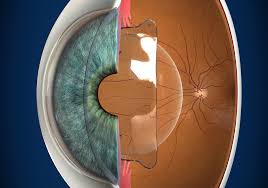
| EVO ICL | Yes — FDA-approved to -15D | No — lens implanted; cornea untouched | No tissue removal; reversible; best option for thin corneas; superior stability for high myopia |
| Trans-PRK | Yes — if corneal thickness allows | Yes (no flap; ablation performed) | No flap risk; better for thin corneas than LASIK; slower recovery than other options |
For a procedure-by-procedure comparison, our guide on Trans-PRK vs LASIK vs SMILE covers candidacy and clinical trade-offs.
Who Should Choose Which Option
| Your Profile | Best Option | Reason |
|---|---|---|
| -9D; corneal thickness 560+ microns; regular topography; stable 2+ years | LASIK or Contoura Vision | Good corneal reserve allows safe ablation with adequate RSB — straightforward candidate |
| -9D; corneal thickness 500–540 microns; borderline RSB | SMILE Pro or EVO ICL | SMILE Pro preserves more structure; ICL avoids ablation entirely — safer for marginal thickness |
| -9D; corneal thickness <500 microns or irregular topography | EVO ICL | No corneal tissue removed; treats -9D safely regardless of corneal thickness; reversible |
| -9D; significant pre-existing dry eye | EVO ICL or SMILE Pro | ICL: no nerve disruption; SMILE Pro: significantly less dry eye than LASIK (published PMC data) |
| -9D; early keratoconus on topography | EVO ICL only | Any ablative procedure (LASIK, SMILE, PRK) is contraindicated — ICL is safe and effective |
Our guide on post-LASIK ectasia explains why the RSB threshold is non-negotiable and what can happen when it is not respected.
Conclusion
A -9D prescription is within the FDA-approved LASIK range. Whether you qualify depends on corneal thickness, RSB, topography, and stability. Published research at -10 to -13.5D shows 51% achieving 20/20 at 24 months (Wallerstein et al., 2020) — outcomes for -9D are somewhat better. EVO ICL and SMILE Pro both treat -9D effectively with fewer corneal constraints. The right answer comes from a full assessment.
Book a consultation at Visual Aids Centre — comprehensive Pentacam mapping and candidacy assessment for high myopia.
Frequently Asked Questions
Is -9 diopter too high for LASIK?
Not automatically — FDA approvals allow LASIK up to -12D. Whether -9D is viable depends on your corneal thickness and residual stromal bed, not the diopter number alone. Patients with 560+ microns of pre-surgery corneal thickness typically have adequate safety margin. Those with thinner corneas are usually better served by EVO ICL or SMILE Pro.
What vision can I realistically expect from LASIK at -9D?
Published research at -10 to -13.5D shows 51% achieving 20/20 and 81% at 20/25 at 24 months, with avg -0.51D regression (Wallerstein et al., 2020). For -9D, outcomes are likely better than this — but typically lower than the all-myopia average of 88.3% at 20/20. Your individual corneal quality affects the result.
Is EVO ICL better than LASIK for -9 diopters?
For many -9D patients, yes — especially with borderline corneal thickness or dry eye. EVO ICL treats -9D without removing corneal tissue, is reversible, and shows superior stability. Published ICL vs LASIK studies show better BCVA outcomes in the ICL group at 3 months (PubMed, 2026). Not universally better — but often the safer, more predictable choice at this power.
Can SMILE Pro treat -9 diopters?
Yes — SMILE Pro treats up to -10D. Candidacy still depends on corneal thickness. SMILE Pro’s advantage at -9D: no flap, significantly less dry eye than LASIK (OSDI MD −4.82 vs LASIK; PMC), and better biomechanical stability. In Delhi, SMILE Pro is exclusively available at Visual Aids Centre.
What happens if LASIK is done at -9D with insufficient corneal tissue?
The primary serious risk is post-LASIK ectasia — progressive corneal thinning and forward bulging causing deteriorating, distorted vision. It may require cross-linking or corneal transplantation in severe cases. This is why the 250–300 micron RSB threshold (AAO guidelines) is non-negotiable, not a suggestion.
👁️ MEDICALLY REVIEWED BY
Padmashree Dr. Vipin Buckshey
BS Ophthalmology | AIIMS Graduate, 1977 | Padma Shri Honouree | High Myopia and Refractive Surgery Specialist, Visual Aids Centre
The thresholds reflect clinical standards at Visual Aids Centre across 250,000+ procedures, cross-referenced with AAO 2022/2024 guidelines, FDA-approved LASIK ranges (CRS Today), and ESCRS guidance. Outcome data: Wallerstein et al. (BMC Ophthalmology 2020) for high myopia LASIK; JRS 2025 meta-analysis for all-myopia LASIK; FDA clinical trial data for EVO ICL; PMC meta-analyses for SMILE. The candidacy decision for any -9D patient requires a comprehensive assessment — this guide provides context, not a personal recommendation. An AIIMS alumnus, Padma Shri honouree, and former President of the Indian Optometric Association. Read more at our story.