
Almost everyone gets some dry eye after LASIK — nearly 95% on day one alone. But here’s what almost no other guide tells you: a real share of that “post-LASIK dry eye” was already there before surgery, just unmasked by the procedure rather than caused by it. This guide breaks the real numbers down day by day, separates near-universal mild symptoms from genuinely rare severe cases, and covers what’s normal versus what’s actually worth a call.
Quick Answer: How Common, By Timepoint
| Timepoint | Share of Patients With Symptoms |
|---|---|
| Day 1 | ❌ ~95% — expected, not a complication |
| Week 1 | ⚠️ ~85% — still very common |
| 1 Month | ⚠️ ~59% — steadily declining |
| 6–12 Months | ✅ ~10–40%, mostly mild |
| Requiring active intervention (punctal plugs) | ✅ ~0.04% in one large military cohort |
Key Takeaways
- Symptoms drop off steeply: roughly 95% on day one, 85% at one week, down to 59% by one month, in one detailed cohort.
- A meaningful share of “post-LASIK dry eye” existed before surgery — published estimates suggest up to half of candidates already show clinical signs of dry eye pre-operatively.
- Severe, intervention-requiring dry eye is genuinely rare — one large military study found punctal-plug-requiring cases in only 0.04%.
- By 6–12 months, most patients have fully recovered; symptoms persisting past a year are uncommon.
- SMILE tends to cause milder symptoms than LASIK in the first 6 months, though the gap narrows by one year — a real but temporary difference.
- In Delhi specifically, dry eye complaints rise sharply during peak pollution season (roughly October–January) — a real local factor most guides never mention.
The Real Numbers, Day by Day
Most articles on this topic quote one blunt figure — “95% have dry eye” — and stop there. A more detailed cohort tracked patients at each stage separately: about 94.8% had symptoms at day one, 85.4% at one week, and 59.4% by one month. That steep early drop-off is the part most guides skip, and it’s arguably more useful than a single headline number, since it shows the sharpest improvement happens fast, not gradually over months.
| Data Point | Figure |
|---|---|
| Symptoms at day 1 | ~94.8% |
| Symptoms at week 1 | ~85.4% |
| Symptoms at 1 month | ~59.4% |
| Symptoms persisting at 6+ months | ~10–40%, mostly mild |
Sources: peer-reviewed post-LASIK dry eye cohort studies; published ophthalmology reviews.
Was Some of This Already There Before Surgery?
Here’s the reframe most “how common” articles miss entirely: a significant share of people considering LASIK already have dry eye before they ever book a consultation, often because long-term contact lens wear — exactly why many candidates seek LASIK in the first place — is itself a common cause of dry eye. That’s part of why candidacy screening checks for dry eye before surgery is even scheduled — treating it beforehand changes what “caused by LASIK” actually means for a lot of patients.
| Data Point | Figure |
|---|---|
| Candidates reporting dry eye symptoms pre-operatively | Up to ~30% |
| Candidates with clinical signs of dry eye on pre-op exam | ~50% |
Sources: published refractive surgery candidacy and dry-eye screening literature.
Why It Happens?
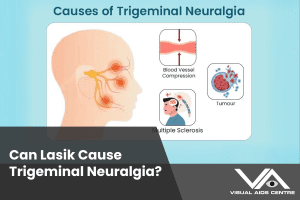
Creating the LASIK flap cuts through corneal nerve fibers that normally signal your eye to keep producing tears — mostly branches of the trigeminal nerve running through the cornea’s outer layers. With that signal temporarily interrupted, tear production drops until the nerves regenerate, which is a gradual process rather than a switch flipping back on. It’s also why you might specifically wake up with drier eyes than you go to bed with — reduced blinking overnight compounds an already-reduced tear response.
Common vs. Rare: Mild Symptoms vs. Severe Cases
Nearly universal and rare are both true at once here, depending on what you’re measuring.
| Severity | How Common | What It Looks Like |
|---|---|---|
| Mild, temporary | ⚠️ Large majority of patients | Grittiness, occasional blurriness, resolves within weeks |
| Moderate, needs drops | Meaningful minority | Ongoing lubricant use for weeks to months |
| Severe, needs active intervention | ✅ ~0.04% in one large cohort | Punctal plugs or comparable treatment required |
If dryness is affecting your vision rather than just comfort, it’s worth understanding how dry eyes can affect visual clarity specifically, since blur from dryness usually clears with a blink and isn’t the same as a focus problem.
SMILE vs. LASIK: Does the Procedure Type Change the Odds?
Since this affects which procedure people choose, it’s worth a direct answer: research comparing SMILE and LASIK consistently finds SMILE patients report milder dry eye symptoms in the first six months, likely because SMILE’s small incision disrupts far fewer corneal nerves than a full LASIK flap. By 12 months, most studies find the gap narrows and the two procedures look similar. It’s a real difference in the early recovery window, not a permanent one.
| Timepoint | What Comparative Studies Show |
|---|---|
| First 6 months | ✅ SMILE — generally milder symptoms, better corneal sensitivity |
| 12 months | Roughly comparable between the two |
Sources: peer-reviewed SMILE vs. FS-LASIK comparative studies and meta-analyses.
Delhi’s Air Quality Adds a Local Factor
If you’re recovering in Delhi, there’s a real seasonal variable most guides never mention: local ophthalmologists have reported roughly a 60% rise in eye complaints, including worsened dryness, during the city’s poorest air-quality stretches — typically October through January, peaking around Diwali. Patients who already run dry, including anyone in the early weeks of LASIK recovery, tend to feel it more during these windows. If your schedule allows it, timing your recovery period away from peak pollution season is a reasonable, concrete consideration.
What Helps at Each Stage?
Treatment isn’t one-size-fits-all — it escalates based on how long symptoms actually stick around.
| Situation | What Helps |
|---|---|
| Most patients, first few weeks | ✅ Preservative-free lubricating drops |
| Symptoms running longer than expected | ⚠️ Full treatment ladder — see treating dry eyes after LASIK |
| Genuinely persistent, more severe cases | Autologous serum drops or scleral lenses |
Bottom Line
Dry eye after LASIK is close to universal in the first days, drops off fast within weeks, and is genuinely rare in its severe form. Some of what gets blamed on LASIK was already present beforehand, which is exactly why pre-op screening for dry eye matters as much as post-op care. For most people, this is a manageable, temporary stretch — not a lasting trade-off.
Concerned about your own risk factors? Book a consultation at Visual Aids Centre — a real pre-op dry eye assessment tells you far more than any general statistic.
Frequently Asked Questions
How common is dry eye after LASIK, and how long does it last?
Very common early on — around 95% of patients have some symptoms on day one, dropping to roughly 59% by one month. Most improvement happens within the first month, with the majority fully recovered by 6–12 months; symptoms beyond a year are uncommon.
Is dry eye after LASIK always caused by the surgery?
Not entirely. Up to half of candidates already show some clinical signs of dry eye before surgery, often from long-term contact lens wear — LASIK can unmask or worsen a pre-existing issue rather than create one from scratch.
Is severe dry eye after LASIK common?
No — mild, temporary symptoms are common, but dry eye severe enough to require active intervention like punctal plugs is rare, reported in well under 1% of cases in large cohorts.
Can dry eye after LASIK affect my vision?
Yes, temporarily — an unstable tear film can cause fluctuating or blurry vision that usually clears with blinking or lubricating drops, distinct from a focus or prescription problem.
What helps most with post-LASIK dry eye?
Preservative-free lubricating drops handle the vast majority of cases. Persistent symptoms have further options, from autologous serum drops to scleral lenses, that your surgeon can discuss if needed.
Does SMILE cause less dry eye than LASIK?
In the first six months, generally yes — SMILE disrupts fewer corneal nerves. By 12 months, most studies find the two procedures produce similar results.
👁️ MEDICALLY REVIEWED BY
Padmashree Vipin Buckshey
BS Optometry | AIIMS Graduate, 1977 | Padma Shri Honouree | Official Optometrist to the President of India | Laser Vision Correction Specialist & Founder, Visual Aids Centre
Dry eye questions come up in nearly every LASIK consultation, and Vipin Buckshey’s approach typically starts by checking what was present before surgery, not just what’s felt afterward. He founded Visual Aids Centre in 1980 — the first eye centre in Delhi to introduce LASIK in 1999 — and has overseen 250,000+ Laser Vision Correction procedures across a 45-year career, with dry eye screening built into candidacy assessment from the start. The prevalence figures here reflect published ophthalmology research, not a proprietary protocol. Read more at our story.