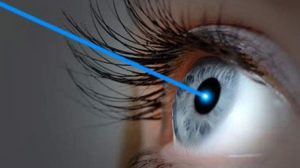

Your vision going black during LASIK is one of the most unexpected sensations patients experience — and one of the most commonly asked about afterwards. It happens, it is completely normal, and it lasts only seconds. This guide explains exactly why it occurs, which part of the procedure causes it, how long it lasts, and what to do if it catches you off guard on the day.
Key Takeaways
- Vision going black during LASIK is normal and expected — it is caused by the suction ring, not the laser.
- The suction ring temporarily raises intraocular pressure (IOP), which briefly reduces blood flow to the retina and causes the blackout — typically lasting 15–30 seconds.
- It happens during flap creation only — the laser correction phase that follows does not cause vision loss.
- The blackout is painless and resolves the moment the suction ring is released.
- Modern femtosecond laser systems use gentler applanation — most patients report the blackout as less dramatic than they expected from reading about it.
- If you are anxious about the procedure, knowing what to expect in advance makes a significant difference to your experience on the day.
Why Does Vision Go Black During LASIK?
The blackout has nothing to do with the laser. It is caused by the suction ring — a device placed on the eye to hold it completely still while the laser creates the corneal flap. When the suction ring is applied, it raises intraocular pressure (IOP) significantly — typically from the normal range of 10–20 mmHg to approximately 65 mmHg or above. This sudden pressure increase briefly compresses the blood vessels supplying the retina. Less blood flow to the retina means the retinal cells temporarily stop receiving the signal they need to produce vision — and the world goes dark.
It is the same basic principle as pressing firmly on a closed eyelid and seeing the visual disturbances that follow — except faster, more complete, and fully controlled. The blackout is not a loss of consciousness, not an anaesthetic side effect, and not an indication that anything has gone wrong. It is a predictable, physiological response to a deliberate and temporary pressure change.
The entire suction phase typically lasts 20–30 seconds. Vision returns to normal within seconds of the suction ring being released — before the laser correction phase even begins. The procedure takes only minutes per eye in total — see our guide on how long LASIK takes per eye for the full timeline.
Which Stage of LASIK Causes the Blackout?
LASIK has two distinct stages. The vision blackout only occurs during the first stage — flap creation.
| Stage | What Happens | Does Vision Go Black? | Duration |
|---|---|---|---|
| Stage 1 — Flap Creation | Suction ring applied to stabilise the eye; femtosecond laser creates a thin corneal flap by delivering precise pulses within the corneal tissue | ✅ Yes — suction raises IOP, temporarily reducing retinal blood flow | 15–30 seconds of blackout; suction phase ~20–30 sec total |
| Stage 2 — Laser Correction | Flap is gently lifted; excimer laser reshapes the corneal stroma to correct refractive error; flap is repositioned | ❌ No — suction ring is removed; IOP returns to normal; vision is dim or blurry but not black | Laser correction: 20–90 seconds depending on prescription level |
During Stage 2, patients typically see a blinking fixation light — a red or green dot to focus on. Vision may look hazy or dim as the laser works, but there is no blackout. Most patients are surprised by how quickly both stages pass. If you are wondering what happens if your eye moves during the procedure, our guide on what happens if you move your eye during LASIK explains how the eye-tracking system manages this.
What You Will Experience — Step by Step
Knowing the exact sequence removes almost all the anxiety around the blackout. Here is what happens from the moment you lie down to the moment it is over.
| Step | What You Experience | Duration |
|---|---|---|
| Anaesthetic drops applied | Eye numbed completely — you will feel no pain during the procedure. Mild stinging from the drops is normal and passes within 30 seconds | 2–3 minutes preparation |
| Eyelid speculum placed | A small clip holds your eyelids open so you cannot blink. This feels like gentle pressure — not painful. You do not need to consciously hold your eyes open | In place throughout |
| Suction ring applied | Firm pressure sensation on the eye — not painful due to anaesthetic. Vision dims rapidly, then goes completely black within a few seconds. This is the moment patients describe as “everything going dark” | 20–30 seconds |
| Flap created (femtosecond laser) | You hear a clicking or buzzing sound. Vision remains black during this phase. You feel nothing due to the anaesthetic | 15–20 seconds |
| Suction ring released | Vision immediately begins to return — first dim, then clearer. This happens within seconds of the ring being removed | Instant |
| Laser correction (excimer) | You see a blinking fixation light — keep your gaze on it. Vision is hazy but not black. A faint smell (not burning — it is the laser breaking molecular bonds) is normal. No pain | 20–90 seconds |
| Flap repositioned | Surgeon smooths the flap back into position. Mild pressure sensation. Vision immediately clearer than before surgery for most patients — often noticeably so within minutes | 30–60 seconds |
The entire procedure per eye takes approximately 10–15 minutes including preparation — but the laser itself is active for under 2 minutes. Preparing mentally is just as important as the physical preparation. Our guide on how to prepare for LASIK surgery covers everything to do in the days before your procedure.
Normal Sensations vs When to Tell Your Surgeon
| What You Experience | Normal? | What to Do |
|---|---|---|
| Vision goes completely black during suction phase | ✅ Normal — expected and universal; retinal blood flow temporarily reduced | Nothing — stay still, breathe normally, it resolves within seconds |
| Firm pressure sensation when suction ring applied | ✅ Normal — significant pressure is needed to stabilise the eye; anaesthetic prevents pain | Nothing — let the surgeon work; do not tense up or try to pull away |
| Clicking or buzzing sound during flap creation | ✅ Normal — femtosecond laser pulse sound; not a malfunction | Nothing — expected acoustic feature of the laser system |
| Hazy or dim (not black) vision during laser correction | ✅ Normal — flap is lifted; vision is temporarily unfocused; fixation light still visible | Focus on the fixation light; blink normally if needed |
| Faint smell during laser correction | ✅ Normal — excimer laser breaking molecular bonds in corneal tissue; not burning | Nothing — completely safe; do not be alarmed |
| Pain during the procedure | ❌ Not expected — anaesthetic should have eliminated pain completely | Tell your surgeon immediately — additional drops can be applied; do not stay silent |
| Vision does not return after suction ring removed | ❌ Not expected — vision should begin returning within seconds of release | Tell your surgeon — extremely rare; requires immediate assessment |
Most patients find the actual experience significantly less dramatic than their anticipation of it. If you are feeling nervous ahead of your procedure, our guide on whether it is normal to feel nervous about LASIK addresses the anxiety many patients feel — and what actually helps. The procedure is also far more comfortable than most people expect — see what patients actually report in our guide on whether LASIK is painful.
Conclusion
Vision going black during LASIK is one of the most predictable, well-understood parts of the procedure — caused entirely by the suction ring temporarily raising intraocular pressure, not by the laser. It lasts 15–30 seconds, it is painless, and vision returns the moment the suction ring is released. The best thing you can do on the day is breathe steadily, stay still, and trust that what you are experiencing is exactly what your surgeon expects and planned for.
Ready to take the next step? Book a LASIK consultation at Visual Aids Centre — our team walks you through exactly what to expect before, during, and after the procedure so nothing on the day catches you by surprise.
Frequently Asked Questions
Is it normal for vision to go black during LASIK?
Yes — completely normal and expected. The suction ring raises intraocular pressure to stabilise the eye during flap creation, which temporarily reduces retinal blood flow and causes a painless blackout lasting 15–30 seconds. Every LASIK patient experiences this.
How long does the blackout last during LASIK?
Typically 15–30 seconds — the duration of the suction phase during flap creation. Vision begins returning immediately when the suction ring is released, before the laser correction stage begins.
Does the laser cause the vision blackout?
No. The laser does not cause the blackout. The suction ring — applied before the laser activates — causes it by temporarily raising intraocular pressure. During the actual laser correction stage, vision is hazy or dim but not black.
Will I be able to see anything during LASIK?
During flap creation: no — vision goes black. During laser correction: yes, partially — you will see a blinking fixation light and the surrounding equipment in a hazy, unfocused way. You are asked to keep your gaze on the fixation light during this phase.
Is the vision blackout painful?
No. Anaesthetic drops numb the eye completely before the procedure begins. The pressure from the suction ring is felt as a firm sensation but not as pain. The blackout itself is a visual experience only — no discomfort accompanies it.
What if my vision does not come back after the blackout?
This would be extremely rare. Vision should return within seconds of the suction ring being released. If you feel vision is not returning, tell your surgeon immediately — they will assess before proceeding. This scenario is not a known complication of modern femtosecond LASIK when performed on a suitable candidate.
👁️ REVIEWED BY
Padmashree Vipin Buckshey
BS Optometry | AIIMS Graduate, 1977 | Padma Shri Honouree | Laser Vision Correction Specialist & Founder, Visual Aids Centre
Vipin Buckshey is an Optometrist and Laser Vision Correction specialist who founded Visual Aids Centre in 1980. In 1999, Visual Aids Centre became the first eye centre in Delhi to introduce LASIK surgery — and has since performed over 250,000 Laser Vision Correction procedures, the highest by any private eye centre in India. He has served as the official optometrist to the President of India. The explanation of suction-ring-induced IOP elevation, retinal blood flow reduction, and the resulting transient vision blackout in this article reflects the procedural standards and patient counselling framework used at Visual Aids Centre across thousands of LASIK procedures. The goal of this guide is to ensure no patient is caught off guard by a sensation that is entirely normal and planned for. Read more at our story.