
Yes — that burning feeling is your eyes healing, not hurting. Mild burning, grittiness, or watery eyes for the first few days comes from corneal nerves temporarily cut during flap creation, not from injury or infection, and it eases as those nerves heal.
Most pages stop at “yes, it’s normal” and leave it there — no explanation of why, and no clear line for when burning stops being normal. Here’s the real nerve mechanism behind it, verified data on exactly how common it is, a genuine LASIK-vs-SMILE healing comparison, and the specific warning signs that actually mean it’s time to call your surgeon.
Key Takeaways
- Burning for 2–5 days is universal, not a complication — it comes from corneal nerves cut during flap creation, not tissue damage.
- Dry-eye-type symptoms show up in 20% to over 50% of LASIK patients across pooled studies — far more common than most patients are told going in.
- Corneal sensitivity drops for about 3 months, with nerves regenerating over roughly 3–6 months for most people.
- SMILE preserves corneal nerves noticeably better early on — nerve fibers were detectable in 100% of SMILE eyes at 1 week vs. just 15.2% of LASIK eyes — though both converge by 6 months.
- Burning with real pain, light sensitivity, or blurry vision in the first 1–2 days is a different, very treatable condition — not routine healing, and almost never covered on LASIK-specific pages.
- Your baseline risk isn’t random — women, patients with higher refractive correction, and deeper ablation depths face significantly higher odds of longer-lasting burning, per a 190-eye study.
The Facts, Verified
Here’s what the published literature actually says, not just generic reassurance.
| Verified fact | Why it matters for you |
|---|---|
| Dry-eye-type symptoms — burning, grittiness, watery eyes — are reported in 20% to over 50% of LASIK patients across pooled studies | Burning isn’t a rare side effect; it’s close to a standard part of early recovery for most patients |
| Corneal sensitivity drops significantly for about 3 months after surgery, with nerves regenerating over roughly 3–6 months | This is literally why the burning fades — your nerves are regrowing, not staying damaged |
| Corneal nerve fibers were detectable in 100% of SMILE eyes at 1 week vs. just 15.2% of LASIK eyes at the same point — though the two converge by 6 months with no significant difference | Explains why some patients report noticeably less early burning depending on which procedure and platform they had |
| Diffuse lamellar keratitis (DLK) — a treatable inflammatory reaction, not an infection — typically appears 1–2 days after surgery with pain, light sensitivity, and blurry vision | This is the one cause of “burning” that needs prompt treatment, and it responds very well to steroid drops |
| In a 190-eye study, chronic dry eye/burning past 6 months showed up in 20% of eyes — significantly more likely with female sex, higher refractive correction, and deeper ablation, even when patients had zero dry-eye symptoms beforehand | Almost no page mentions this: your baseline risk is partly predictable from your prescription and profile, not just chance |
Sources: Frontiers in Medicine (post-LASIK dry eye review); PLOS ONE (SMILE vs. FS-LASIK nerve reinnervation study); EyeWiki (DLK reference).
Why Do Your Eyes Actually Burn After LASIK?
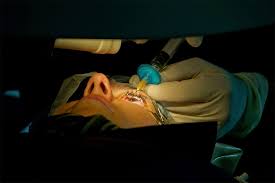
Creating your corneal flap means cutting through a dense mesh of corneal nerves — the same nerves responsible for blink reflex, tear production, and surface sensation. That temporary nerve transection is what actually causes the burning, grittiness, and watery feeling, not the laser reshaping itself. It’s a predictable, expected part of how LASIK affects your tear film in the days after surgery, and it resolves on the same timeline your nerves take to regrow.
Platform choice plays a role too — SMILE’s small keyhole incision disturbs far fewer corneal nerves in the first three months than a full hinged flap, part of why some patients notice less early burning with one laser platform versus another; by six months, healing largely evens out. Pre-existing dry eye or ocular surface issues also make this phase feel more intense, which is why your ocular surface health before surgery is part of your pre-op evaluation.
What Does Your Burning Actually Mean?
| What you’re feeling | What it means | Action |
|---|---|---|
| Mild burning or grittiness, first 2–4 days, no real pain | ✅ Normal nerve-healing phase | Use your prescribed lubricating drops and avoid rubbing your eyes |
| Burning with excess tearing or light sensitivity, first week | ✅ Still the normal dry-eye phase | Continue drops as directed; sunglasses outdoors help |
| Real pain, photophobia, and blurry vision, day 1–2 | ⚠️ Possibly DLK — treatable, not an emergency | Contact your clinic promptly; steroid drops resolve this well |
| Burning that persists for many months with no other cause | ❌ Worth a dedicated evaluation | Ask your surgeon about it directly — see below |
Sources: EyeWiki clinical reference on DLK; general post-LASIK ocular surface guidance.
If your action plan is unclear beyond “use drops,” the full post-LASIK care routine covers what to do day by day, and what’s actually safe to do with your eyes in that first week answers the more specific version of that question.
When Should You Actually Worry?
Almost never, for the ordinary burning-and-grittiness pattern — that’s simply your nerves healing on schedule. The exception worth knowing precisely: if burning arrives with genuine pain, photophobia, and blurred vision in the first day or two, that’s more likely diffuse lamellar keratitis, an inflammatory reaction under the flap. It sounds alarming, but it responds very well to prompt steroid treatment — it’s not the same thing as an infection, and it’s not routine nerve-healing burning either, which is exactly why it’s worth telling apart.
| Timeframe | What’s typical | What to expect |
|---|---|---|
| Day 1–2 | Burning, grittiness, watery eyes; peak DLK-watch window if pain/photophobia appears | Prescribed drops; contact clinic only if real pain accompanies it |
| Day 3–7 | Gradual easing, still some dryness | Normal — keep using drops as directed |
| Week 2–4 | Burning largely resolved for most patients | Residual dryness is still common and expected |
| Month 3–6 | Corneal nerves substantially regenerated | Burning persisting well beyond this point is worth flagging |
Source: Frontiers in Medicine post-LASIK dry eye review; EyeWiki DLK reference.
Beyond the DLK pattern above, call your clinic the same day — rather than waiting for your next scheduled visit — if you notice any of these:
- Sharp or stabbing pain that doesn’t ease with your prescribed drops
- Pain severe enough that you can’t keep the eye open
- Discomfort that’s worsening rather than improving after 48 hours
- Pain bad enough to disrupt sleep
The genuine outlier, and the piece most LASIK-specific pages skip entirely: for a small number of patients, burning or discomfort persists for months rather than weeks, well past the 3–6 month nerve-regeneration window, with no dry eye, no DLK, and no other obvious cause. That pattern is distinct from routine post-LASIK dryness and is worth a dedicated conversation with your surgeon — our detailed page on corneal neuralgia rates and treatment after LASIK covers this rarer, longer-lasting scenario specifically, separate from the normal healing curve described above.
Bottom Line
Burning eyes for the first few days after LASIK is expected nerve-healing, not a sign anything went wrong, and it fades within weeks as corneal nerves regrow. Use your prescribed drops, skip the urge to rub, and treat real pain or light sensitivity as a reason to call rather than wait. If you’re still deciding on your procedure, our LASIK eye surgery guide and our team are both good next stops.
FAQs
Is this the same as the burning smell some patients report during LASIK?
No — that’s a completely different phenomenon caused by the laser vaporizing corneal tissue during the procedure itself. See what that burning smell during surgery actually is if you’re curious about it separately.
Can I use over-the-counter eye drops instead of what my surgeon prescribed?
Stick with what’s prescribed for the first week or two — some OTC drops contain preservatives that can irritate a healing surface.
Does burning mean my flap might be at risk?
No — burning is a nerve-sensation issue, not a flap-stability one; flap concerns present differently, usually as sudden visual distortion.
How long until the burning fully stops?
Most people notice real improvement within 1–2 weeks, with full resolution as corneal nerves regenerate over roughly 3–6 months.
Will choosing SMILE instead of LASIK guarantee I avoid this?
Not a guarantee, but the data leans that way early on — SMILE eyes showed far higher nerve-fiber detectability in the first month. By six months, healing largely evens out between the two procedures.
What if burning comes back months after I thought I’d fully healed?
A new trigger (screen strain, allergies, seasonal dryness) is the common explanation, but persistent unexplained burning long after healing is complete is worth mentioning to your surgeon directly.
👁️ MEDICALLY REVIEWED BY
Padmashree Dr. Vipin Buckshey
Optometrist & Laser Vision Correction Specialist | AIIMS Graduate, 1977 | Padma Shri Honouree | Official Optometrist to the President of India | Former President, Indian Optometric Association | Founder, Visual Aids Centre
Burning or gritty eyes in the first week are one of the most common questions patients ask after LASIK, and knowing the actual nerve mechanism behind it tends to settle nerves faster than reassurance alone. Dr. Vipin Buckshey founded Visual Aids Centre in 1980, and in 1999 it became the first eye centre in Delhi to introduce LASIK. The centre reports over 250,000 Laser Vision Correction procedures to date. This article reflects published clinical literature on post-LASIK ocular surface healing and is general information rather than medical advice — contact your surgeon directly if burning comes with real pain, light sensitivity, or vision changes. Read more at our story.